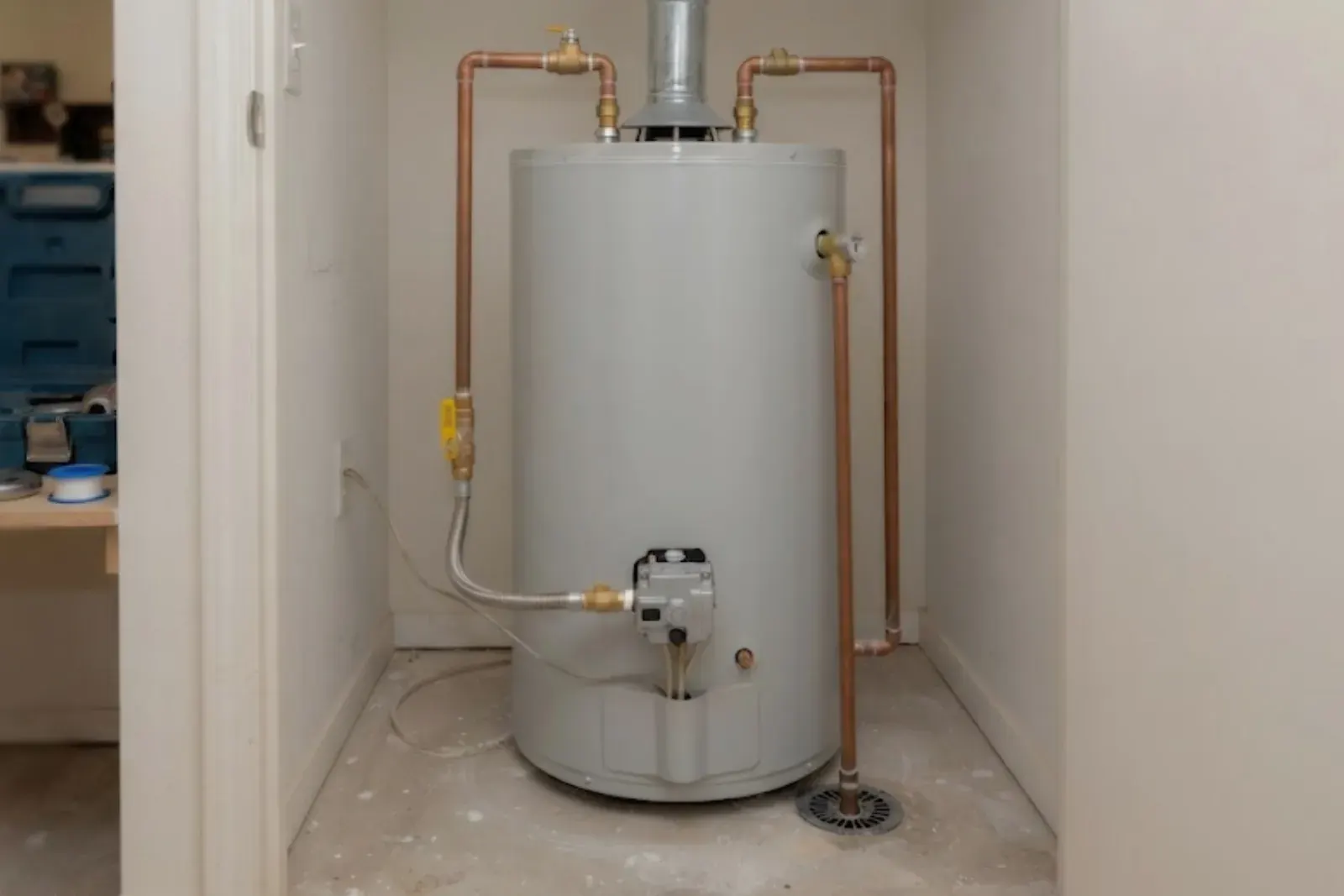
Start with the date on the rating plate
Look at the sticker on the side of the tank. The serial number normally encodes the month and year it was built, and the maker's website will decode it if the format is unclear. Anything built more than ten years ago deserves a harder look at every symptom below.
Under 248 CMR 10.14, a thermal expansion tank is required near the meter when a check valve or backflow preventer makes a closed system, which is a standard item on a replacement.
By that age the steel tank has gone through thousands of heating cycles. The glass lining that protects the steel develops hairline cracks, and the anode rod, a sacrificial metal stick that corrodes so the tank does not, is often eaten down to the core wire.
Four signs the tank is wearing out
Rust-colored hot water
If only the hot tap runs brown or orange while the cold side stays clear, the inside of the tank is corroding. Rust in both lines points at old supply pipes instead.
Moisture around the base
A drip from a fitting or the drain valve can be fixed. Water weeping from the tank shell cannot, because the steel itself has failed and the tank will keep getting worse.
Rumbling, knocking or popping
Mineral sediment settles on the tank floor and hardens. Water trapped beneath it flashes to steam and makes the noise, and the layer also insulates the water from the burner or element.
Less hot water than before
Sediment takes up volume, and a failing dip tube or element can mix cold water in. If showers run cold sooner than they used to, the tank is losing capacity.
Repair or replace: a quick decision table
| What you see | Likely cause | Usual call |
|---|---|---|
| Puddle under the tank, shell wet | Corroded tank wall | Replace |
| Drip at the pipe connections on top | Loose or worn fitting | Repair |
| Water runs out of the relief valve discharge pipe | Bad valve or excess pressure | Repair first, then test |
| No hot water on an electric unit | Failed element or thermostat | Repair if tank is young |
| Pilot will not stay lit on a gas unit | Thermocouple or gas valve | Repair if tank is young |
| Popping noise plus tank over ten years old | Heavy sediment | Replace soon |
Why sediment noise is a bigger deal than it sounds
Flushing a young tank once a year keeps loose sediment from packing down. On a tank that is already noisy and old, the layer has often fused into a crust that a flush will not remove. Opening the drain valve on a tired tank can also leave it dripping afterward, since the valve seat gets stirred up with grit.
The practical read: if the tank is past ten years and the noise is loud, plan the swap instead of paying for a flush that buys little.
Energy use and the slow efficiency slide
Older tanks carry thinner insulation, and a sediment blanket makes the burner or element run longer to heat the same water. If your gas or electric bill has crept up with no change in how the household uses hot water, an aging heater is a reasonable suspect. Newer tanks hold heat better and recover faster.
When a repair still makes sense
Thermostats, heating elements, igniters, thermocouples and relief valves are all replaceable parts. On a tank under about seven years old with a clean interior, water heater repair is the cheaper path in relative terms. We give a firm price before any work starts, so you can compare the two options on paper.
Danvers water and housing: what it means for your tank
The Town of Danvers treats its water with pH adjustment and phosphates for corrosion control, and the town's report points out that white scaling on faucets and shower heads may come from calcium carbonate. No hardness figure is published, so ask the Water Division for its annual water quality report or test your own tap. Scale on fixtures hints that minerals are also collecting in your tank.
Danvers also has older housing: about 25 percent of homes were built in 1939 or earlier and roughly 70 percent before 1980. A house that old can have a heater in a basement corner with tight clearances, original vent pipe or aging gas and water connections around it. That is worth checking when the tank comes out.
Source type: Town of Danvers water supply page and Census ACS 2020 to 2024
Neighboring towns see different water
Water changes from town to town, and so does tank wear. The Topsfield system serves its wells through a treatment plant because its source water carries high iron and manganese, and those minerals can stain fixtures and shorten water heater life, which is worth keeping in mind for Topsfield owners. Across the south line, Peabody draws on the city's reservoir system, so ask the Peabody Water Department for its quality report before guessing at tank lifespan.
If the tank is leaking right now
First steps while you wait
A leaking tank can empty into a finished basement fast. Do these in order.
- Turn off the electric breaker or set the gas control to off or pilot.
- Close the cold water shutoff valve above the tank.
- Open a hot tap upstairs to relieve pressure and stop the refill.
- Move boxes and electronics off the floor near the tank.
- Call our 24/7 line at (855) 575-2890 for a licensed plumber.
Safety Checklist Before You Call
- Turn the gas valve to off or switch the breaker off at the panel, depending on the heater.
- Close the cold water shutoff valve on the line feeding the tank.
- Do not touch the tank or the relief valve discharge, because the water can be scalding.
- Keep stored boxes and electronics away from the pooling water.
- Note the age on the rating plate so the plumber can plan the swap.
Pick the next heater before the old one quits
A planned swap lets you choose size, fuel type and whether a tankless model suits the house. The state plumbing code table lists the residential hot water range as 120 to 130 degrees Fahrenheit, so a replacement unit gets set inside that band. An emergency swap leaves you with whatever is on the truck.
Water heater replacement questions
Most last about 8 to 12 years. Heavy mineral content, never flushing the tank and a worn anode rod all shorten that. A well-kept unit can run longer, but past 12 years you are borrowing time.
It depends on where the water is coming from. Leaks at fittings, the drain valve or the relief valve are repairable. A leak through the tank wall is not, and the tank must be replaced.
Rust itself is mostly a nuisance and a staining problem, but it signals that the tank interior is failing. Do not wait for the leak that usually follows. Have it looked at while you can schedule the work.
Sometimes on a young tank with soft, loose sediment. On an old, loud tank the deposit is often hardened, and a flush may only disturb the drain valve. A plumber can tell you which situation you have.
Yes, the line runs around the clock, so a failed tank at 2 a.m. gets a call back and a plan. Close the cold valve above the tank first to limit damage.
The town adds pH adjustment and phosphates to limit pipe corrosion, and its report mentions calcium carbonate scale on fixtures. No hardness number is published, so the real effect on your tank depends on your own water. Ask the Water Division for the annual report or test your tap.