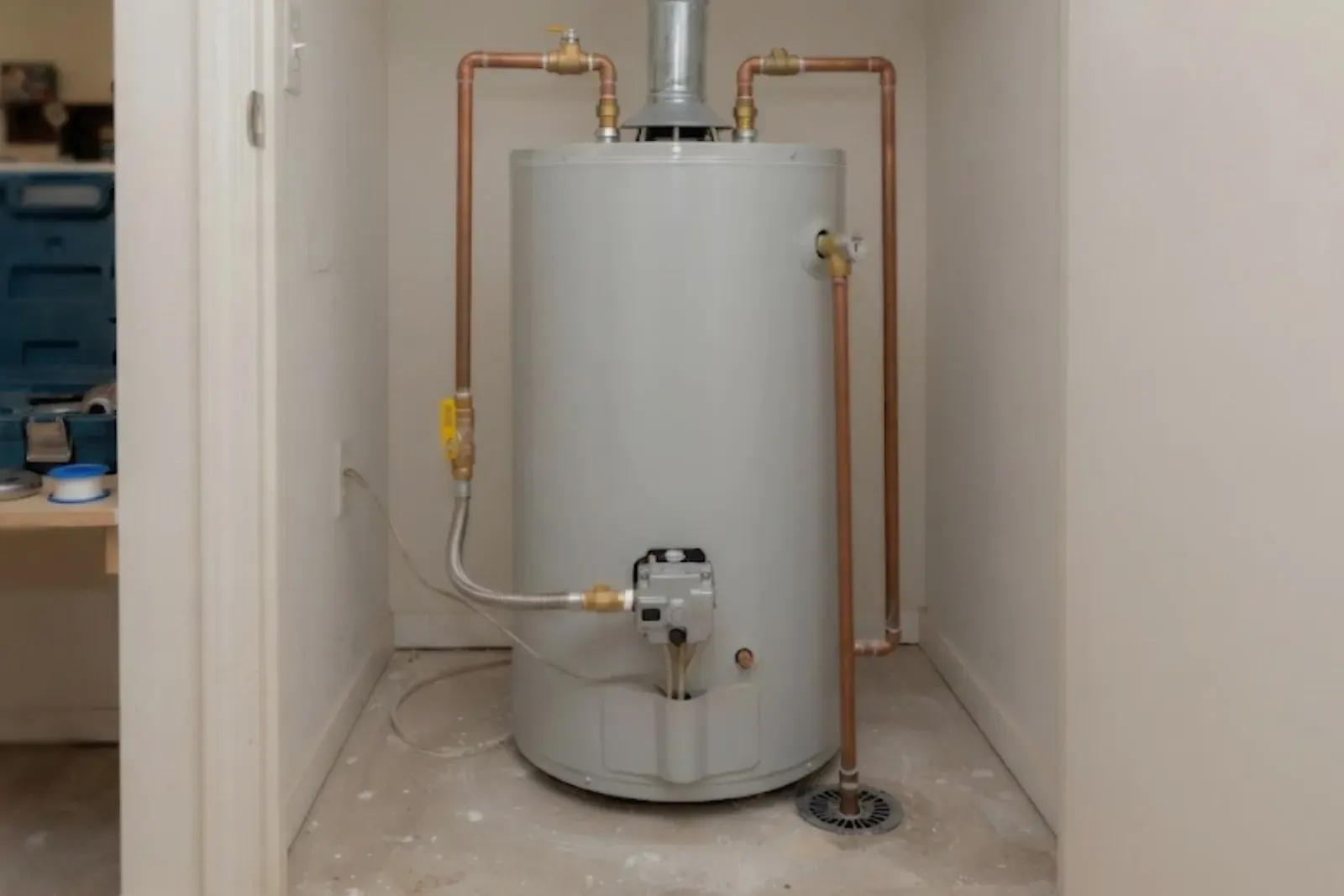
Replace Or Repair: The Quick Test
Ask two things. Is the water coming from the tank body, not a fitting? Is the heater near the end of its usual service life? If the answer to the first is yes, replacement is the only option, because a corroded steel shell cannot be sealed.
Under 248 CMR 10.14, the relief valve discharge must be full-size with no shut-off and end at a fixture or within 12 inches of the floor, a standard we install to.
If a single part has failed and the tank is sound, water heater repair usually costs far less than a new unit. We lay out both choices at your house and let you pick. Where the tank has a rusted base, a failed anode or repeat repairs behind it, putting more money into it rarely pays off.
| What we find | Points toward | Reason |
|---|---|---|
| Water leaking from the tank body | Replace | A rusted shell cannot be patched |
| Failed thermostat or element, tank dry and clean | Repair | The tank is still sound |
| Rust-colored hot water only | Replace | Interior is corroding |
| Repeat failures within a year | Replace | Parts are chasing a worn system |
| Pilot or thermocouple only | Repair | A small, inexpensive part |
| Heater well past its normal life | Replace | Failure risk is rising |
Sizing The Tank To Your Household
A tank that is too small runs out during back-to-back showers, while one that is too large wastes energy keeping extra water hot. The number to look for is first-hour rating, which shows how much hot water the heater delivers in its first hour of heavy use. It matters more than the tank volume printed on the label.
Count the people, bathrooms and big users such as a soaking tub or a dishwasher that draws hot water. About 69.5 percent of Danvers homes predate 1980, so a house that has added a bath or two over the decades may need a bigger heater than the one it started with. Tell us how mornings go and we size from that.
Gas, Electric Or Something Else
Replacing like for like is the simplest path. A gas tank into a gas tank reuses the venting and gas line, while a switch to electric needs a dedicated circuit and a different layout. A move to a tankless water heater changes the gas line size and venting, which is why it is a larger job.
If you are changing fuel or moving the heater, our water heater installation page covers that work in more detail. Gas in town is supplied by National Grid, and electricity comes from Danvers Electric, so a fuel change may involve a call to the utility.
Tank down and no time to shop?
Call now and we will go through sizing and fuel over the phone.
Permit Rules In Plain Terms
Massachusetts requires a permit before plumbing is installed, altered, removed, replaced or repaired. A water heater swap falls under the general replaced rule, and permits go only to licensed plumbers. Danvers Inspectional Services, at 1 Sylvan Street, handles local permits, but no Danvers page spells out when one is needed, so we confirm for your job.
Anyone can check a plumber's license through the state's online license lookup. Only a master or journeyman licensed by the Board of State Examiners of Plumbers and Gas Fitters may do the work. That protects you if something goes wrong later, since an unpermitted heater can cause trouble at a home sale or an insurance claim.
Relief Valve And Expansion Tank Rules
Under 248 CMR 10.14, a storage heater needs a properly sized temperature and pressure relief valve within 12 inches of the top of a vertical tank. The discharge pipe must be full size with no shut-off valve, ending at a fixture or within 12 inches of the floor. We do not reuse a tired valve on a new tank.
A thermal expansion tank is allowed under the code, and one is required near the meter when a check valve or backflow preventer makes your plumbing a closed system. Danvers water rules call for supply protection and backflow testing twice a year. No check valve may sit in the cold supply to the water heater itself. We check your setup so heating does not spike pressure.
How Replacement Day Goes
Shut down and drain
We close the supply, kill the fuel or power and drain the old tank to a floor drain or hose line.
Disconnect and remove
Gas, water, vent and electrical connections come apart and the old tank leaves the house.
Set and connect
The new tank goes on a level base or pan, with new flex lines, a relief valve, discharge pipe and any expansion tank.
Test and explain
We fill, purge air, check for leaks and combustion, set the temperature and show you the shutoffs.
Most swaps finish in a single visit when parts match. A change of fuel, venting or location can add time. For temperature, the code range for residential hot water is 120 F minimum to 130 F maximum, with a stated exception, so we set it there.
What Drives The Price
The cost of a new heater depends on the unit you choose and the work around it. A firm price comes before we remove anything.
Insurance seldom pays to replace a heater that wore out, though sudden water damage from a failure may be covered.
Want a firm number for your heater? Call (855) 575-2890
If the old tank flooded the basement, a sump pump check is worth doing while we are there.
Before You Replace Your Water Heater
Yes. Our 24/7 line dispatches a licensed plumber for failed and flooding heaters, and same-day appointments are offered when available. A swap that cannot finish after hours may start with shutoffs and temporary steps.
Call and tell us the fuel and where the water is coming from.
Service life varies with the tank, water quality and maintenance. A heater that is leaking, rumbling heavily or giving rusty hot water is at the end regardless of age.
We check the tank before we call it.
State rules require a permit before plumbing work is installed, altered, removed, replaced or repaired, and permits go only to licensed plumbers.
Danvers Inspectional Services handles local permits. We confirm what applies to your house.
The code allows one, and it is required near the meter when a check valve or backflow preventer closes the system. Without one, heating water can push pressure up and cause the relief valve to drip.
We look at your meter setup.
Yes, but it needs a dedicated electrical circuit and the gas line is capped. It is a bigger job than a like-for-like swap.
We explain what is involved before you commit.
The code range for residential hot water is 120 F minimum and 130 F maximum, with an exception noted. We set it in that range and show you the dial.
Maybe. Tankless units save space and give continuous hot water but need proper gas supply and venting, and they need descaling. See our tankless water heater page.