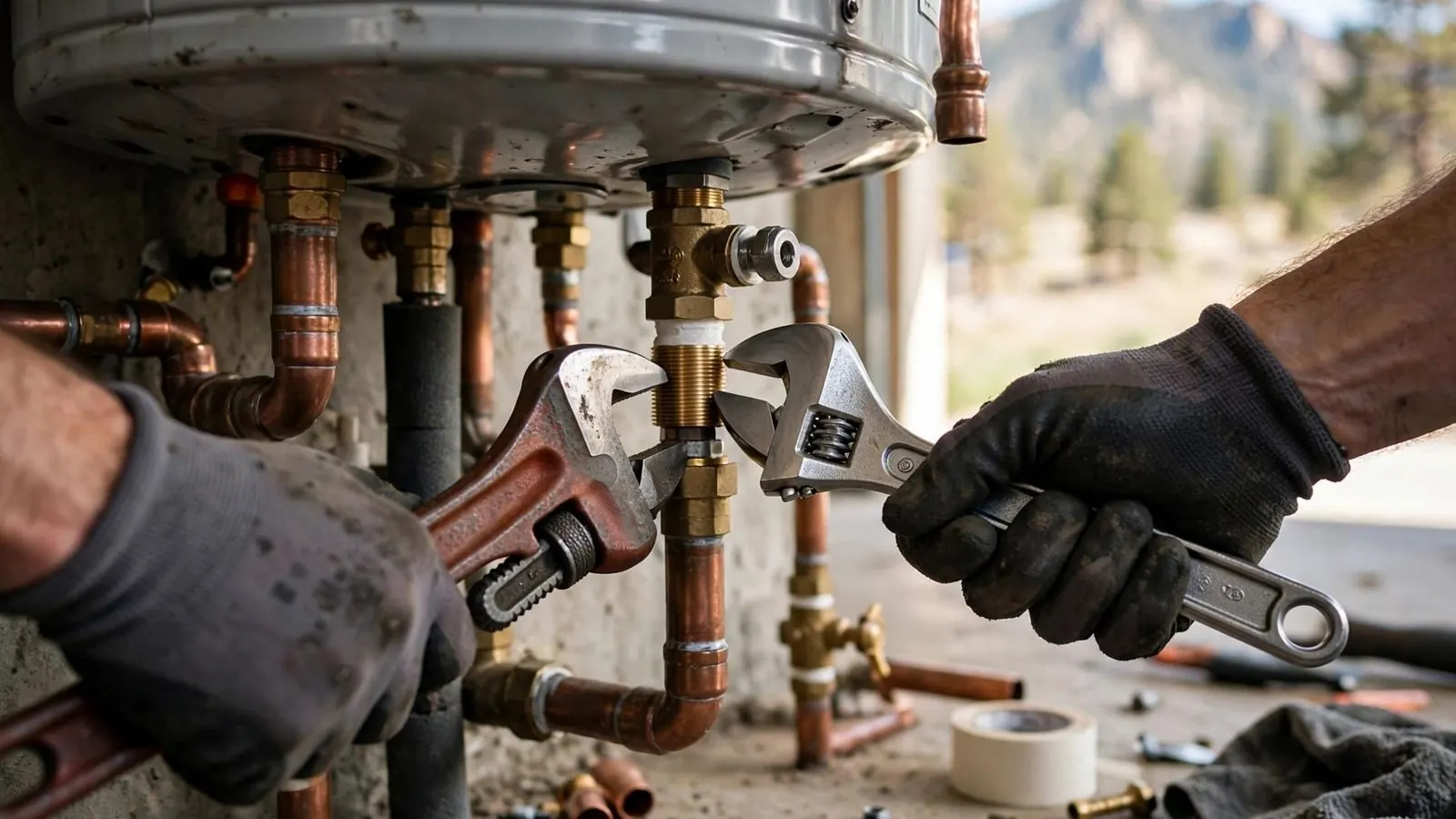
Planning Before The Tank Arrives
Most installation problems are planning problems. A heater has to sit on a level, protected floor, with room to service the burner or elements, a drain nearby and a path for its vent or power. Walls, closets and low basement ceilings in older Danvers houses often limit the choice.
About 43.5 percent of Danvers homes were built before 1960. Those houses often have a chimney flue sized for an older boiler, narrow stair access and a basement with a single floor drain. We look at all three before we suggest a unit, because the best heater on paper is useless if it will not fit through the bulkhead.
Fuel Type Conversions
Changing fuel is the largest variable in an installation. Going from electric to gas needs a gas line, a vent and a combustion air path. Going from gas to electric needs a dedicated circuit sized for the heater and capping of the old gas branch.
Gas service in Danvers is National Grid and electric service is the municipal Danvers Electric division, so a conversion may mean a call to the utility about meter capacity. We do not guess. We check the panel and the gas meter before quoting, so a surprise upgrade does not appear halfway through.
| Conversion | New work needed | Main constraint | Permit |
|---|---|---|---|
| Electric to gas tank | Gas line, vent, combustion air | Vent route to a chimney or wall | Yes, state rule |
| Gas to electric tank | Dedicated circuit, cap gas branch | Panel capacity | Yes, state rule |
| Tank to tankless gas | Larger gas line, new vent | Gas supply volume | Yes, state rule |
| Same fuel, new location | Extended water, gas or power lines | Distance and access | Yes, state rule |
| Add a second heater | Manifold or parallel piping | Space and demand | Yes, state rule |
Venting In General Terms
A gas heater has to carry exhaust out of the house safely. That can be a metal flue into a lined chimney, a sidewall vent with a fan, or a sealed plastic vent for condensing units. The right one depends on the heater type and the available path, and the manufacturer lists what is allowed. A tankless water heater uses a different vent and a larger gas line than a tank.
Never reuse a corroded vent or tie a new high-efficiency heater to an old chimney without checking the liner. A loose or blocked flue pushes carbon monoxide into the home. Detectors on every floor are the safety net, but a correct vent is the real protection.
Planning a new heater?
Call to talk through fuel, location and timing before you buy a unit.
Permit And Licensing
The Massachusetts rule is that no plumbing work may be installed, altered, removed, replaced or repaired until a permit is issued. Permits go only to licensed plumbers, and only a master or journeyman licensed by the Board of State Examiners of Plumbers and Gas Fitters may do the work. Danvers Inspectional Services at 1 Sylvan Street handles local permits. Customers in nearby Peabody deal with their own city office instead.
You can look up any plumber on the state's license lookup before you hire. We pull the permit as part of the job and schedule the inspection, so the work is on record.
Code Items That Come With Every Install
Under 248 CMR 10.14, a storage heater needs a properly sized temperature and pressure relief valve within 12 inches of the top of a vertical tank. Its discharge must be full size, with no shut-off valve, ending at a fixture or within 12 inches of the floor. A tank with a relief pipe aimed at the wall is a flood waiting to happen.
- No check valve may be installed in the cold supply to the water heater
- Residential hot water is set between 120 F minimum and 130 F maximum, with an exception noted
- A thermal expansion tank is allowed by the code and required near the meter if a check valve or backflow preventer closes the system
- A drain pan or floor drain protects finished space below or beside the tank
The expansion tank is the item homeowners miss most. Heating water expands, and if the plumbing is a closed loop, that pressure has nowhere to go but the relief valve or your fixtures.
Installation Day
Walk-through
We confirm location, vent path, shutoffs and any utility work before we turn a wrench.
Rough-in
Lines, vent, gas or electric are run to the heater location and tested.
Set and connect
The tank goes in with relief valve, discharge pipe, pan and expansion tank where needed.
Inspect and start
We fire or power the unit, check combustion and leaks, and set up your inspection.
What Drives The Price
Two installs of the same tank can cost very different amounts. A firm price comes before work starts.
Insurance does not usually cover planned upgrades, though some utilities and programs offer rebates for efficient models. Ask before you buy.
Want a firm number for your project? Call (855) 575-2890
For larger projects, such as a remodel with a new bath, our plumbing installation team can coordinate the heater with the rest of the plumbing.
Installation Questions
The line is open all day and night, and a dispatcher can book a planned installation visit or send help if a heater fails. Same-day appointments are offered when available.
For a flooding tank, say so at the start of the call.
Yes, if your panel has room for a dedicated circuit. The gas branch is capped and the vent is removed or sealed.
We check the panel first and tell you if an upgrade is needed.
Massachusetts requires a permit before plumbing is installed, altered, removed, replaced or repaired, and permits go only to licensed plumbers.
We pull it for you.
It absorbs the extra volume when water heats in a closed system. The code allows one, and it is required near the meter when a check valve or backflow preventer closes the system.
We check your setup.
The code prohibits it because it traps pressure between the valve and the tank. The relief valve then has to take the load.
If a check valve exists at the meter, an expansion tank handles it.
At a fixture or within 12 inches of the floor, full size and with no shut-off valve. A capped or reduced pipe defeats the safety device.
We plumb it to a visible, safe spot.
Usually yes, if the new spot allows the vent, drain and power or gas. Longer pipe runs and new access work add to the job.
A site visit settles it.