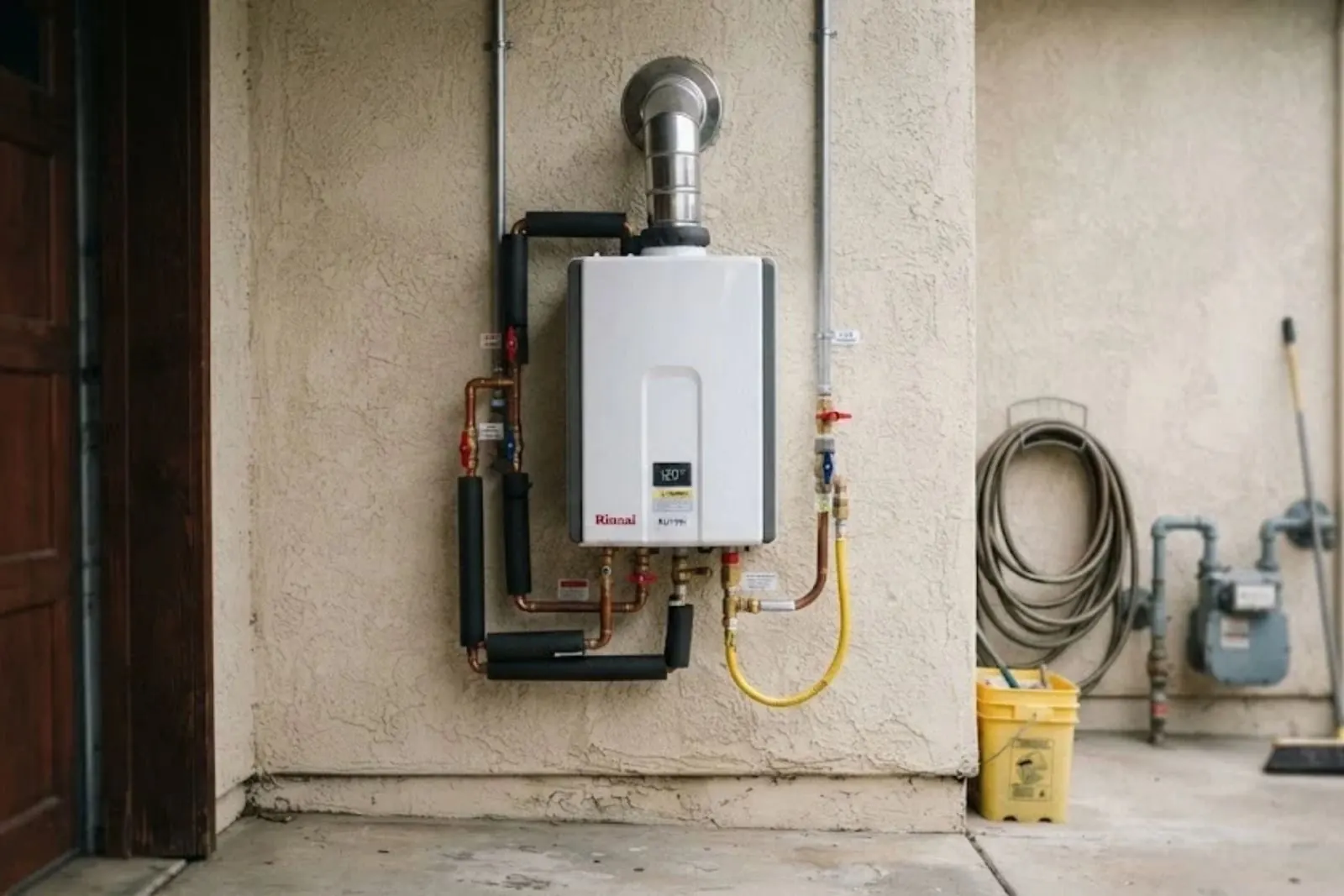
The Flush Your Tankless Unit Is Asking For
A flush circulates a mild descaling solution, usually white vinegar or a manufacturer-approved product, through the heat exchanger and out of the unit using a small pump and hoses. It removes the mineral crust that builds on the inside of the narrow passages. The job is done through isolation valves on the water lines, which is why a good installation includes them.
Signs it is due include a fluctuating temperature, a slower flow at the tap, a unit that fires and shuts off, or an error code related to flow or overheating. Skipping flushes can shorten the life of the exchanger. If you only need a flush, you do not need a new heater, and we say so.
Water turns lukewarm
Scale on the exchanger blocks heat transfer, so the unit cannot hit its setpoint at normal flow.
Cold sandwich effect
Hot water surges, then goes cold, then returns. Scale or a dirty inlet filter can cause the swings.
Error code on the display
Many codes mean flow, ignition or exhaust trouble. Write down the code before you reset it.
Noise or kettling
A popping or rumbling sound suggests scale where water boils in a hot spot.
Why Testing Your Tap Matters Here
The Town of Danvers says white scaling or hard deposits on faucets and shower heads may come from calcium carbonate. That is the same mineral that coats a heat exchanger. The Town does not publish a hardness number, so you cannot assume a figure for your house.
The plumbing code table in 248 CMR 10.14 lists a residential hot water range of 120F minimum and 130F maximum, with an exception noted, which is the standard to keep in mind when setting output temperature.
Test your tap with a simple hardness kit, or ask the Water Division for its annual water quality report. If your water leaves scale on the showerhead, set a flush schedule sooner rather than later. If it does not, flushes can be spaced out, and you save the cost.
Tankless unit acting up?
Call and read us the error code on the display.
Tankless Troubleshooting: What We Check First
We start with the cheap and common items. The inlet water filter screen can clog with debris. The flow sensor needs minimum flow to start the burner, so a low-flow faucet may never trigger the unit. A shower mixing valve that allows cross flow between hot and cold can also confuse the sensor.
Then we look at gas pressure under load, the vent for blockage and the condensate drain on high-efficiency models. Condensing units produce acidic water, and a blocked drain trips them offline. If a unit leaks, we check the exchanger, the unions and the condensate line before blaming the whole heater. A tank-style failure is covered under water heater repair.
| Symptom | Likely cause | First check | Typical outcome |
|---|---|---|---|
| No hot water, display on | Low flow or clogged filter | Inlet screen, faucet aerator | Clean and retest |
| Lukewarm output | Scale in exchanger | Flush with isolation valves | Flush restores heat |
| Ignition fails | Low gas pressure or line size | Pressure under load | Gas line fix |
| Unit shuts off on exhaust code | Blocked or damaged vent | Vent path | Clear or replace vent |
| Leak at the cabinet | Union, exchanger or condensate | Source of the wet spot | Repair or replace |
| Frozen or cracked exchanger | Cold exposure | Location and heat | Often replace |
Gas Line And Venting Needs
A tankless burner uses far more gas for a short time than a tank burner does. The pipe that fed a 40-gallon tank may be too small, which causes ignition faults and low output. Sizing depends on the pipe length, the other appliances on the line and the unit rating.
Venting also differs. Many units use sealed plastic vent or stainless pipe through a sidewall, not a chimney, and the manufacturer sets length and clearance limits. For a conversion from a tank, see our guide on water heater installation, which covers permits and fuel questions in more detail.
When A Tankless Unit Is Worth Choosing
- You want continuous hot water for a large family or a soaking tub
- You are short on floor space in a basement or closet
- You can supply the gas line and venting without major rework
- You are willing to flush it on a schedule
If a tank has failed and you are comparing, our water heater replacement page explains tank sizing and code items. Tankless units are not always cheaper over time, and their value depends on the work around them.
Permits And Licensing
Massachusetts requires a permit before plumbing is installed, altered, removed, replaced or repaired, and permits go only to licensed plumbers. A gas appliance conversion involves both plumbing and gas fitting. Danvers Inspectional Services at 1 Sylvan Street handles local permits. Neighbors in Middleton share our water system but use their own inspection office.
What Drives The Price
A flush costs far less than a repair, and a repair costs less than a new tankless install. A firm price comes before work begins.
A tankless unit that wore out or scaled up is a maintenance cost, not an insured event. Water damage from a sudden leak may be covered.
Want a firm number for your unit? Call (855) 575-2890
Tankless Questions Answered
It depends on your water and how much you use. Test your tap and check the showerhead for white scale, and ask the Water Division for the annual water quality report.
If scale shows up, a yearly flush is a sensible start.
It is possible with isolation valves, a small pump and hoses, but errors can damage the unit or leave vinegar in the lines. Many owners prefer to hire it out.
We can flush and check gas and vent at the same time.
Low flow, scale, a clogged inlet filter or a mixing valve that crosses hot and cold can all cause it.
A technician checks each in order.
Yes, we service tankless units as well as replace them, and we say plainly if a repair is not worth it.
Give us the make and any error code when you call.
Often not without a change. Tankless burners draw more gas at once, so the line may need a larger size.
We test pressure under load before quoting.
Yes. The line is open 24/7. Shut off the water and gas to the unit if it is safe, and call.
Same-day appointments are offered when available.
Yes, the Massachusetts rule covers plumbing that is installed, altered or replaced, and permits go to licensed plumbers.
We handle the application and inspection.