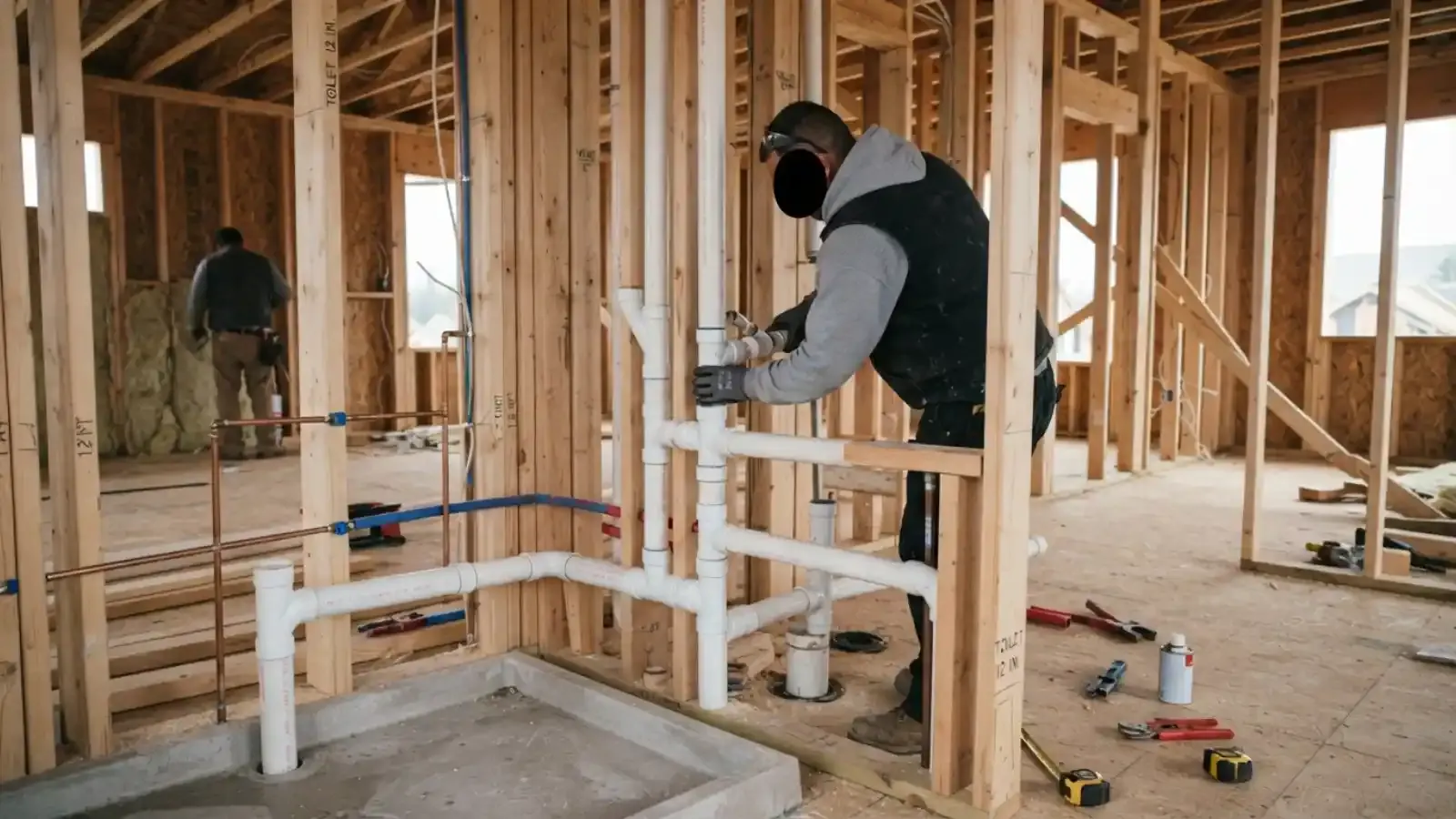
Rough-In First, Finish Second
Every installation splits into two phases. Rough-in is the plumbing that goes inside walls and floors: drain and vent pipes, supply lines, stub-outs and shutoff valves. Finish work comes after drywall and tile, when the fixtures, faucets and trim go on.
New plumbing in Massachusetts is governed by the Uniform State Plumbing Code, 248 CMR 10.00, which is the standard a licensed plumber installs to.
The two phases are separated by inspection. The local inspector looks at the roughed-in pipe before it is covered, which is why a plumber is booked twice on a bathroom project. Cover the walls too early and the inspector can ask you to open them again.
| Phase | Work | Who else is involved | Inspection |
|---|---|---|---|
| Rough-in | Drains, vents, supply, valves | Framer, before drywall | Yes, before closing walls |
| Pressure test | Supply lines held under pressure | None | Part of rough inspection |
| Finish | Toilet, sink, tub, faucets | Tiler and painter done first | Final inspection |
| Startup | Water on, leak check, flow test | Homeowner walk-through | As required |
Fixtures We Install
- Toilets, including wall-hung and comfort-height models
- Bathroom and kitchen sinks, vanities and pedestal basins
- Tubs, shower valves and shower pans (tile and enclosure belong to others)
- Outdoor spigots and frost-free hose bibs
- Dishwasher, refrigerator ice-maker and laundry connections
- Utility sinks and basement bathrooms
For swapping an existing faucet or valve, see faucet repair. If your installation is a new water heater, see water heater installation.
Planning a remodel or new bathroom?
Call and we will talk through the plumbing before the walls go up.
Remodels in Older Danvers Houses
About 43.5 percent of Danvers homes were built before 1960, and about 69.5 percent before 1980. Opening a wall in one of those houses often reveals galvanized supply, cast iron drains or older vents that do not meet current layout. Allow for this early, since adding a bathroom may mean replacing a stack that was never sized for it.
That is the practical reason to hire the plumber before the contractor closes the budget. If the old pipe is failing anyway, repiping the affected branch while the wall is open costs less than doing it later.
New Construction Plumbing
For a new house or an addition, plumbing starts with the site: where the water service enters, where the sewer connection exits and how deep the lines must sit. Massachusetts frost line depth is 48 inches, so a buried water line has to go below that to stay out of freezing ground.
The Town of Danvers requires a backwater valve where basement sewage discharge is below the rim elevation of the closest public sewer manhole. The valve goes in before the sewer connection exits the building. The town also bars sump pumps, roof downspouts, foundation drains and area drains from the building sewer. Plan the sump discharge to the yard. Our sump pump page covers it.
Water Softeners and Filters
Before you buy any treatment equipment, find out what is in your water. The Danvers water report notes that white scale on faucets and shower heads may be calcium carbonate, but the town does not publish a hardness figure. Ask the Water Division for its annual water quality report, then test your tap.
A cheap home test strip gives a rough hardness reading, and a lab test is more exact. If the water is hard, a salt-based softener helps scale in kettles, fixtures and water heaters. A carbon filter at the kitchen sink improves taste, and under-sink reverse osmosis cleans drinking water further.
| System | Fixes | Needs | Watch for |
|---|---|---|---|
| Salt softener | Scale, soap film | Salt refills, drain connection | Salt in drain discharge |
| Whole house carbon filter | Chlorine taste, odor | Filter changes | Pressure drop if undersized |
| Under-sink reverse osmosis | Drinking water quality | Cartridges, a drain saddle | Wasted water, slow fill |
| Sediment filter | Grit, rust flakes | Regular replacement | Clogs quickly |
A softener also needs a place to drain its backwash, a nearby outlet and a bypass valve, which is plumbing we install.
Permits and Licensed Work
The Commonwealth requires the local plumbing inspector to issue a permit before plumbing is installed, and permits go only to licensed plumbers. Under 248 CMR 3.05 no plumbing may be installed, altered, removed, replaced or repaired until a permit is issued. Replacing or relocating a faucet counts too, though a leaky faucet fix does not.
Danvers Inspectional Services at 1 Sylvan Street handles local permits. No Danvers page states when a permit is required for a given job, so ask there if you are unsure. Only a master or journeyman plumber licensed by the state may do plumbing work, and you can verify a license on mass.gov.
What Drives the Price
An install quote depends on fixtures, access and permits. You get a firm price before work starts.
Installations are normally not an insurance matter, though a lender or insurer may ask for proof the work was permitted.
Want a firm number for your project? Call (855) 575-2890
We work across the north shore, and a shop in Topsfield can also read our page for a plumber in Topsfield.
Installation Questions
Yes, the 24/7 line is always open. Installations are scheduled, but if a new connection leaks overnight, call and a plumber will respond.
Massachusetts requires a permit before plumbing is installed, and permits go only to licensed plumbers. Ask Danvers Inspectional Services if you are unsure.
Rough-in is the pipe inside walls and floors, inspected before closing. Finish is the fixtures and faucets set after tile and paint.
First check your water. Ask the Danvers Water Division for the annual water quality report, test your tap, and compare scale on fixtures.
Yes in most cases. Tell us the model so we can check that the rough-in matches the fixture.
Often yes, though below-grade bathrooms may need a sewage ejector. Check that the sewer connection is protected by a backwater valve where required.