Why Danvers Houses Reach the Repipe Question
Census data puts 25.4 percent of Danvers housing, about 2,930 homes, at 1939 or earlier, and about 69.5 percent before 1980. Pipe from those eras was often galvanized steel or early copper, and some houses have had a mix of both added over the decades.
That mix matters. Galvanized pipe rusts from the inside, narrowing the bore until pressure drops. Copper lasts longer but can pit, and where copper meets steel without a dielectric fitting, corrosion speeds up. A house with a 1950s kitchen and a 1990s bath may therefore have three different pipe ages in one wall.
Pipe Materials You Might Find
| Material | Typical era | How it fails | Our view |
|---|---|---|---|
| Galvanized steel | Before about 1960 | Rust narrows bore, brown water | Replace, rarely worth patching |
| Copper (hard) | 1950s onward | Pinholes, joint leaks, pitting | Spot repair if few leaks |
| Polybutylene (gray plastic) | Roughly 1978 to 1995 | Fittings and pipe split without warning | Replace when found |
| CPVC | 1980s onward | Brittle with age | Check at joints |
| PEX | Recent decades | Fittings and UV damage if exposed | Common modern choice |
We confirm the material by looking in the basement, the water heater connections and under sinks, then open a small access point if needed. Never guess from the faucet side alone.
Signs Your Pipes Are Failing
Brown or orange water
Rust is flaking from galvanized pipe walls. If it clears after running a few minutes, the rust is coming from the pipe and not the main.
Weak flow at several fixtures
Mineral and rust buildup closes the bore. Pressure at the street can be fine while the faucet barely trickles.
Repeated pinhole leaks
Green stains or tiny sprays on copper mean the wall is thin. Fix one and another appears nearby.
Ceiling or wall stains
Water finding its way through framing can run a long way from the source. See leak detection to trace it before opening walls.
Wondering if your pipes are due?
Call us for a plumber to inspect and give a clear price before work starts.
Repipe or Spot Repair: How We Decide
A single failed joint or one section above the water heater is a spot repair, and we say so. The picture changes when leaks recur, when pressure falls house-wide or when the pipe material is known to fail, as with polybutylene.
A rough rule: if you have fixed three leaks in a year, or if you can see pitting at every joint we open, the pipe is telling you it is done. Patching an old line that is failing everywhere simply moves the leak down the line. Your own plans count too. Selling in a year, or opening a bathroom wall for a remodel, may tip the choice.
Questions That Settle It
- Is the pipe material one of the known failure types?
- How many leaks in the past two years?
- Is low pressure house-wide or one fixture?
- Are walls already open for a remodel?
- Do you plan to stay or sell soon?
Two or three yes answers usually point toward repiping.
PEX Versus Copper
| Factor | PEX | Copper |
|---|---|---|
| Installation | Flexible, fewer fittings, less wall access | Rigid, soldered joints, more openings |
| Freeze tolerance | Expands without splitting as readily | Splits when frozen |
| Longevity | Long record but newer | Decades of proven service |
| Water taste and scale | Neutral | Can pit in aggressive water |
| Sunlight | Must be covered | No problem |
| Cost | Usually lower in material and labor | Higher |
Copper is the choice when pipes sit exposed in a finished basement or when you want a traditional material. PEX wins on speed and on fewer openings in plaster or tile. Either can be right. Danvers sits above a frost line of 48 inches, so any run that crosses an unheated crawl space or exterior wall needs insulation whichever pipe you choose.
What Happens to Your Walls
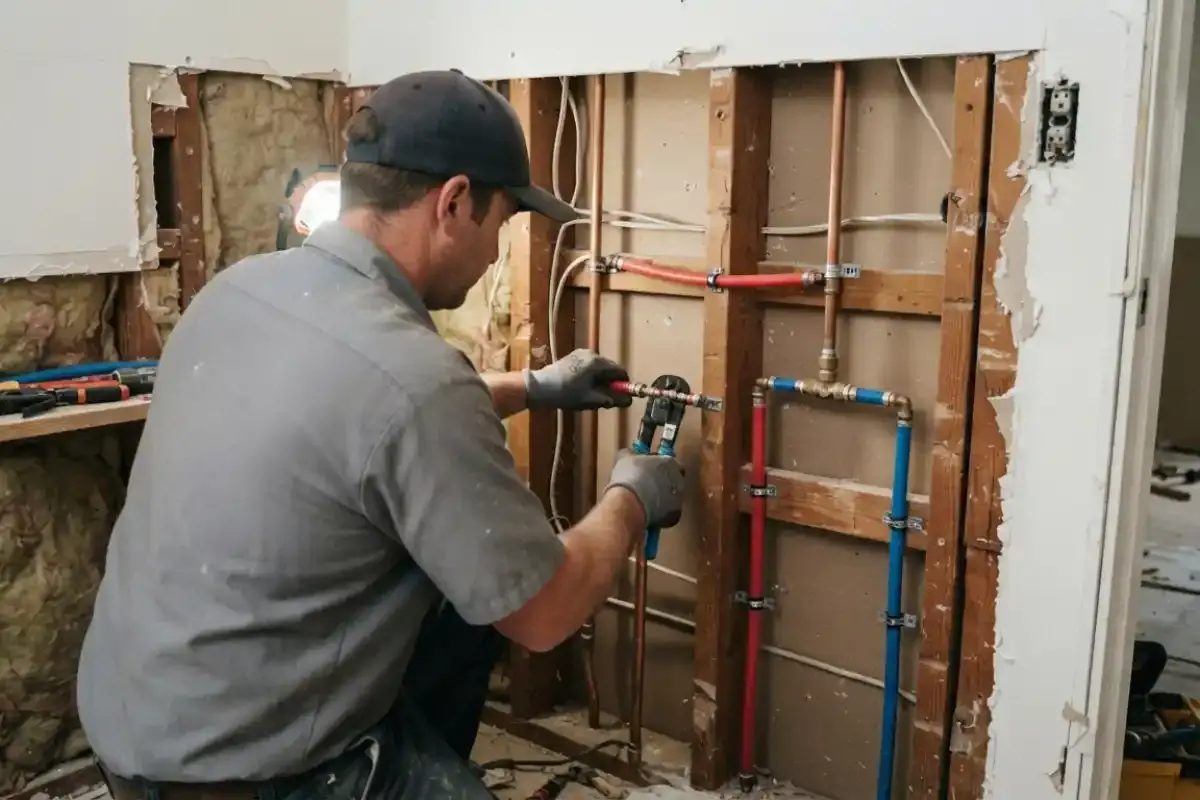
Flexible PEX can be fished through existing cavities from the basement and attic, so most access holes are small and sit in closets, behind fixtures or at the ends of runs. Copper needs more openings. Plaster and lath, common in houses from before 1940, are slower to open and patch than drywall.
We plan runs to minimize cuts and protect floors. Patch and paint is normally a separate trade, and we say where that line falls before starting. Most homes keep water for at least part of each day, since the job proceeds room by room.
Safety Checklist Before We Arrive
- Locate your main water shutoff and make sure it turns.
- Clear the basement and the area around the water heater so the crew can reach the pipes.
- Move furniture and valuables away from walls where pipes will be opened.
- Plan a period without running water on the day of the work, and fill a few containers beforehand.
- Photograph any stains or wet spots so we can see where leaks started.
Permits and Licensing
Massachusetts requires the local plumbing inspector to issue a permit before plumbing is installed, and under 248 CMR 3.05 no plumbing work may be installed, altered, removed, replaced or repaired until one is issued. Permits go only to licensed plumbers, and only a master or journeyman plumber licensed by the state may do the work.
Danvers Inspectional Services at 1 Sylvan Street handles local permits. You can verify any plumber through the state license lookup on mass.gov. A repipe done without a permit can complicate a sale or an insurance claim later.
What Drives the Price
Repiping is priced to the house. After we see it, you hear a firm figure before work starts.
Insurers rarely pay to replace pipe just because it is old, but they may cover resulting water damage from a sudden failure.
Want a firm number for your house? Call (855) 575-2890
If a pipe outside the house is the actual trouble, that is water service line repair. A split pipe that is flooding right now belongs to burst pipe repair. Homeowners in Beverly can also find a plumber in Beverly.
Repiping Questions
Galvanized pipe is gray, threaded at its joints and attracts a magnet. Scratch a hidden spot with a key: galvanized shows silver, copper shows orange.
Yes. The 24/7 line answers any hour, and a split pipe is dispatched as an emergency while the full repipe is scheduled later.
It is a gray plastic pipe used in some homes roughly from the late 1970s to the mid 1990s. Its fittings and walls are known to fail, so we recommend replacing it when found.
It depends on the size and access. A small home can be done in a few days, while a large or plastered house takes longer.
Usually water is shut off for part of each day, not the whole job. We tell you the schedule in advance.
PEX approved for potable use is standard in homes. Ask us which brand and rating we install.
Danvers reported 2023 tap sampling results with 1 of 32 sites above 15 ppb. Your own service line and plumbing are different, so ask the Water Division or test your tap.