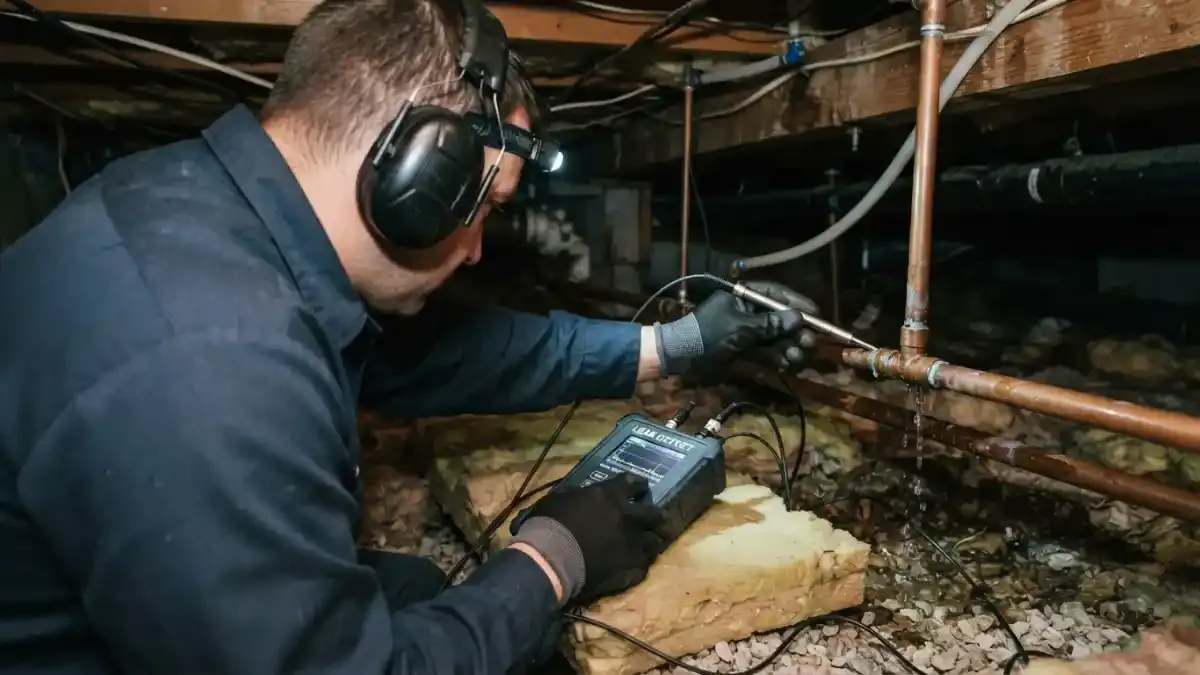
Finding Water You Cannot See
A hidden leak announces itself indirectly: a bill that climbs for no reason, a meter that keeps turning, a warm patch on a floor, the sound of running water at 3 a.m. Each clue narrows where to look, and the order matters. We confirm that a leak exists, decide whether it is on the supply side or the drain side, and only then bring out the locating gear.
Supply lines hold pressure all day, so they leak steadily. Drain lines leak only when something runs, which is why a mystery stain that grows after laundry day points to a drain or a vent connection.
According to the Town of Danvers, the town owns and maintains the water service up to and including the curb stop, so a leak past that point is generally the owner's to fix.
Rising water bill
Usage drifts up month after month though nobody changed habits. A slow leak is a likely suspect.
Meter moves with everything off
The dial or low-flow indicator keeps turning after all fixtures are closed.
Warm or damp floor
A hot water line under a floor can warm one patch while the rest stays cool.
Musty smell or bubbling paint
Moisture inside a wall shows up as odor, stained drywall or paint that blisters.
Is the Meter Telling on You? A Test Anyone Can Run
Your water meter is the best leak detector in the house. It records every drop that passes, so if it moves while nothing is on, water is going somewhere. Meters are often in a basement or utility area, though some sit in an outdoor box near the street.
Shut everything off
Close faucets, stop the dishwasher and washer, pause the ice maker and any softener cycle, and switch off irrigation.
Read the meter
Note the dial numbers or watch the small low-flow triangle or star. If it spins now, you already have an answer.
Wait and read again
Leave the water off for 30 to 60 minutes, then compare. Any change means water is escaping.
Close the house main
Shut the main valve inside the house. If the meter keeps moving, the leak sits between the meter and that valve, often underground.
A toilet flapper that leaks into the bowl is the most common cheap culprit, and a few drops of food coloring in the tank will reveal it in fifteen minutes. If the meter test says the leak is real and the toilet is clean, call us. A bill that creeps up is also worth a look at the water service line if the meter points outside.
Meter still running with everything off?
Call the 24/7 line. We trace the leak instead of cutting into the house to guess.
What Each Locating Tool Can and Cannot Do
No single device finds every leak. Good detection means picking the tool that suits the pipe, the material and the surface, then confirming with a second method. Here is how they compare in plain terms.
| Tool | Best use | Honest limit |
|---|---|---|
| Acoustic listening | Pressurized metal pipe, slab and buried lines | Plastic pipe carries little sound, and traffic or running appliances drown out a small hiss |
| Thermal camera | Hot water leaks, wet insulation, radiant tubing | Shows temperature differences, not water. Cold-water leaks are harder to see |
| Tracer gas | Leaks in pipe that sound and heat miss | Needs the line isolated and filled, and gas must reach the surface through soil or concrete |
| Moisture meter | Confirming damp drywall, wood or subfloor | Reads moisture, not where it started |
| Pressure test | Proving a line or zone holds pressure | Tells you there is a leak but not where |
| Sewer camera | Drain lines and cracks | Shows pipe interiors only, not supply leaks |
That honesty matters. A tool that points at a wall is a pointer, not a verdict, and we will say how confident we are before anyone opens drywall.
Slab Leaks: Signs, Doubts and Honest Odds
A slab leak is a break in a pipe that runs under or inside a concrete floor. Not every Danvers house has one to worry about, since many older New England homes sit over basements and crawlspaces. Slabs are more common under additions, garages and some newer builds, so the question to ask is whether any part of your home sits on grade.
Telltale signs include a warm spot on the floor, the sound of running water with fixtures off and a meter that moves with no visible wet area. About 69.5 percent of Danvers homes were built before 1980, so supply lines of older metals are plausible in some houses. We confirm with a meter test and listening before suggesting anything invasive.
When a slab leak is real, the options are a spot repair through the floor, rerouting the line through walls and ceilings, or replacing the run. See repiping if the same pipe has failed before.
Stains on the Ceiling and Damp Spots in Walls
A ceiling stain is rarely right under the leak. Water travels along joists and pipes before it shows, so the wet spot may sit several feet from the source. Before we cut, we check above the stain for a supply line, a drain joint, a shower pan, a tub overflow or a roof leak.
Wall leaks are usually a failed joint, a nail through a pipe or a worn supply valve behind a fixture. A thermal camera and moisture meter often find the edge of the wet area, and a pressure test tells us whether the supply is the source. If the break is in a burst section, the fix belongs on our burst pipe repair page.
Water coming through a ceiling or wall right now
Act in this order before the plumber arrives.
- Shut off the main water valve, then open a low faucet to relieve pressure.
- Turn off power to the affected room at the breaker if you can do it from a dry spot.
- Move furniture and valuables, and put buckets under drips.
- Poke a small hole in a bulging ceiling to drain it into a bucket and avoid a collapse.
- Take photos for insurance before cleanup.
Call the 24/7 line after the water is off so we can arrive ready to find the source.
Buried Lines, Yard Wet Spots and the Meter Box
Water in a yard may be a leak, a spring or just rain. A patch that stays soft in dry weather, lush grass over one line of ground or a drop in pressure points to the supply. The Town owns and repairs the service up to and including the curb stop. The owner generally handles the pipe from there to the building when the stop sits in the public way.
That split decides who to call. A wet meter box at the street usually means the Water Division, while water at the house wall is yours. We can tell you which side you are on, then pinpoint the spot with acoustic gear or a tracer gas test. See our water service line repair page for what comes next.
Irrigation Zones That Lose Water
Sprinkler systems fail in quiet ways: a cracked riser, a stuck valve, a broken head hidden under mulch. A soggy corner, a pressure dip in one zone or a bill spike in summer can all point here. Run each zone and watch the meter for the loss.
Danvers water regulations require an approved backflow device on irrigation systems and call for backflow testing twice a year. A leaking vacuum breaker or backflow assembly is a common drip, and it is part of that test routine. Winterizing before the first hard freeze prevents cracked fittings.
A Short Word on Pools and Spas
Pools lose water to evaporation, so a drop does not prove a leak. A bucket test compares the pool level to a bucket left on the first step over a day or two. If the pool drops faster than the bucket, the leak may be in the skimmer, the return lines or the shell.
Shell and liner work is a specialist's job. We focus on the house plumbing, the equipment pad lines and the supply to the pool.
Crawlspace and Under-House Leaks
Where there is a crawlspace, leaks often show up as sagging insulation, dark floor joists, a musty smell or drips you can hear from the room above. Cold-water pipes sweat, too, so condensation can mimic a leak. We follow the pipe by hand and light, using moisture readings and a pressure test to separate a leak from sweat.
Frozen pipes are a related risk in unheated crawlspaces. If you ever find a split after a deep freeze, shut the main before the thaw, because the pipe leaks only once the ice melts.
What Drives The Price
Leak detection cost depends on how hard the leak is to reach and how many methods it takes to confirm it. We give a firm price before work begins.
Some policies cover the cost of locating a leak and the resulting water damage, while others cover only the damage. Ask your insurer before you call.
Want a firm price to find your leak? Call (855) 575-2890
When a Leak Is an Emergency
Any leak that cannot be stopped at a fixture valve, soaks wiring or ceiling drywall or runs from the main line is urgent. Our 24/7 line takes those calls overnight and on holidays, with same-day appointments when available for slower leaks. If you are unsure, shut off the main and call.
Heavy rain can soak basements near brooks and low ground, and that looks a lot like a leak. A dry-weather meter test separates the two. If the water appears only after storms, our sump pump page is the better fit, and we dispatch to neighbors such as Peabody as well.
Leak Detection Questions We Hear Most
Check your meter with every fixture off. If the dial moves, water is escaping. Unexplained bill increases, damp spots, mildew smell and the sound of running water at night are other signs.
Turn off all water use, note the reading and the low-flow indicator, wait 30 to 60 minutes with nothing running, and read again. Any change is a leak. Then close the house main and see whether it still moves to learn if the leak is inside or outside.
Yes. Our line is open 24/7 and a licensed plumber can be dispatched for active leaks at any hour. Shut off the main valve, protect the electrics and call while the water is stopped.
Often we can narrow it to a small area using listening gear, thermal imaging and pressure testing. The repair itself may still need floor access. No tool is perfect, and we tell you how sure we are.
It depends on the policy. Some pay for locating the leak when damage resulted, others only cover the damage itself. Ask your carrier and keep photos and a written report.
The Town owns and repairs the water service to and including the curb stop. From there to the building, the owner generally handles it. We can help you work out which side the leak is on.
It sees temperature differences, so it works best on hot water and wet insulation. A cold-water leak in a cold wall can look like nothing. We pair it with moisture and pressure checks.
We handle the house plumbing and equipment pad lines. Shell and liner leaks need a pool specialist. A bucket test tells you whether evaporation or a true leak is at work.