Humming, Stuck, Silent or Dripping
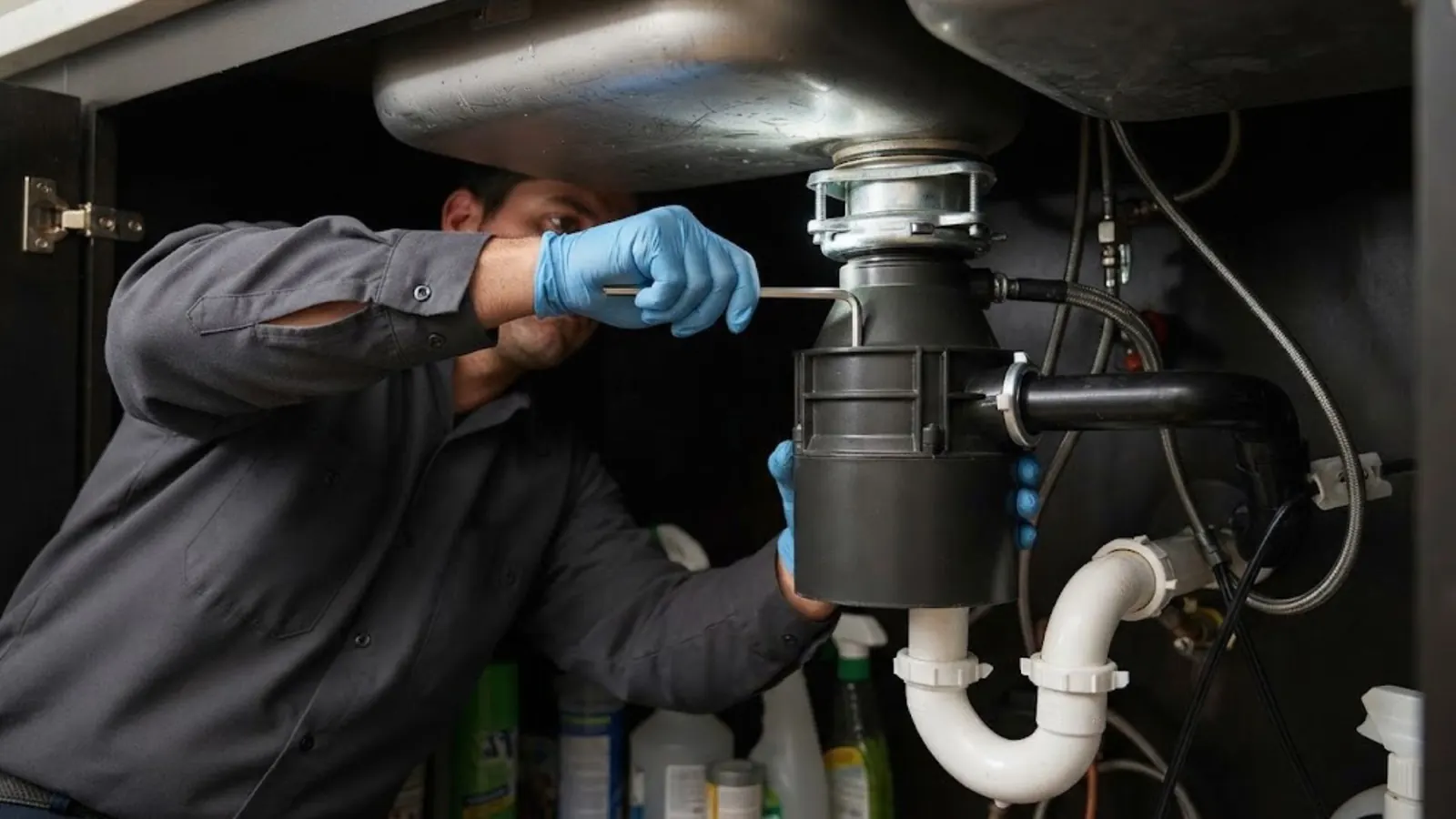
A garbage disposal grinds food with a spinning plate and two small lugs, driven by a motor under the sink. The grinding chamber is bolted to the drain at the sink flange, and a discharge pipe carries waste to the trap. The symptom tells you which of those has failed.
Under the state rule in 248 CMR 3.05, no plumbing work may be installed, altered, removed, replaced or repaired until a permit is issued, and that standard covers a disposal swap too.
Hums but does not spin
The plate is jammed, often by a bone, fruit pit or utensil. The motor is working against the jam and can burn out if left running.
Completely silent
The overload protector has tripped, or the outlet or wall switch has lost power. The red reset button may fix it.
Water under the sink
The leak comes from the sink flange, the dishwasher hose, the discharge pipe or a cracked housing. A dry paper towel test shows which.
Sink fills while it runs
The drain line is blocked beyond the disposal, so ground waste cannot leave. It is a plumbing clog, not a motor failure.
Jam Safety Steps
Before you touch anything in the drain:
- Turn the wall switch off and unplug the unit, or switch off its breaker.
- Shine a flashlight inside and pull out any object with tongs or pliers, never your fingers.
- Insert a hex key into the socket at the bottom of the unit and turn it back and forth to free the plate.
- Press the red reset button on the underside, restore power and run cold water as you test it.
If it trips again immediately, stop and call. Repeated resets can overheat the motor.
Disposal leaking or dead?
Call the 24/7 line and a licensed plumber will come to your kitchen.
What Never Belongs Down the Disposal
- Grease, fat and cooking oil, which coat the discharge pipe and harden in the trap
- Coffee grounds in quantity, which pack into a paste
- Potato peels and pasta, which swell into a gluey mass
- Celery, corn husks and other fibers that wrap the plate
- Bones, fruit pits and shells, which jam the lugs
- Chemical drain cleaners, which attack seals and splash when you reach in
Run a strong flow of cold water for about fifteen seconds after each use so the pieces reach the main drain. Hot water melts grease briefly, then lets it set further down the line.
A Leak Under the Sink: Four Places to Look
| Location | What you see | Likely cause | Fix |
|---|---|---|---|
| Top, at the sink flange | Water around the drain ring | Dried plumber's putty or loose mount | Reseat the flange |
| Dishwasher hose inlet | Drip at a small side stub | Loose clamp | Retighten or replace the hose |
| Discharge pipe | Drip at the elbow | Worn gasket | New gasket |
| Bottom or side of the housing | Water from the body | Cracked or corroded casing | Replace the unit |
A leak from the body means the unit is finished, since there is no seal to renew. The other three are repairs that often take under an hour.
When the Drain Line Is the Real Problem
A disposal sends solids into a small kitchen branch line, and that is where the damage builds. If the sink backs up even when the unit is working, the pipe past the trap is partly blocked with grease. A cable pass fixes it, and a stubborn buildup may call for hydro jetting to strip the pipe wall.
Danvers asks residents not to flush so-called flushable wipes because they do not break down, and the same logic applies to a kitchen line. In houses from before 1960, which is about 43.5 percent of Danvers housing, the kitchen drain may be old cast iron or galvanized steel with a rough interior that catches debris. See drain cleaning for how we clear and test a kitchen branch.
Replacing a Garbage Disposal
Replace the unit if the housing leaks, the motor will not restart after a clean reset, or it jams over and over. Horsepower matters: a quarter or a third horsepower model struggles with heavy use, while a half horsepower and up grinds more finely. Continuous-feed units run while the switch is on, and batch-feed units need a stopper in place.
Most swaps reuse the mounting ring and drain connections, but the electrical connection needs care. A hardwired unit should be disconnected at the breaker first. State rules say no plumbing is installed or replaced until a permit is issued and that permits go only to licensed plumbers, so ask us how the swap is handled. A leaking faucet beside the disposal is often fixed during the same visit.
What Drives the Price
Clearing a jam and fitting a new unit are very different visits. You get a clear price before work starts.
Sudden water damage from a failed disposal can be a homeowners claim, while a worn-out motor itself is not.
Need a firm number for your kitchen? Call (855) 575-2890
Disposal Questions
Yes. Our 24/7 line dispatches a licensed plumber for leaks under the sink and flooded kitchens at any hour, including weekends and holidays.
It is a small red button on the bottom of the unit. Let the motor cool for a few minutes after a jam before you press it.
Something is wedged against the grinding plate. Use the hex key socket under the unit to work it free after switching off power.
Small amounts of citrus peel freshen it, and ice cubes can knock off residue, though neither replaces cleaning. Avoid fibrous peels in quantity.
Many last about eight to fifteen years depending on use. One that jams often or leaks from its body is near the end.
Probably not. A slow sink is usually a blocked drain line past the trap, which needs a cable or jetting.