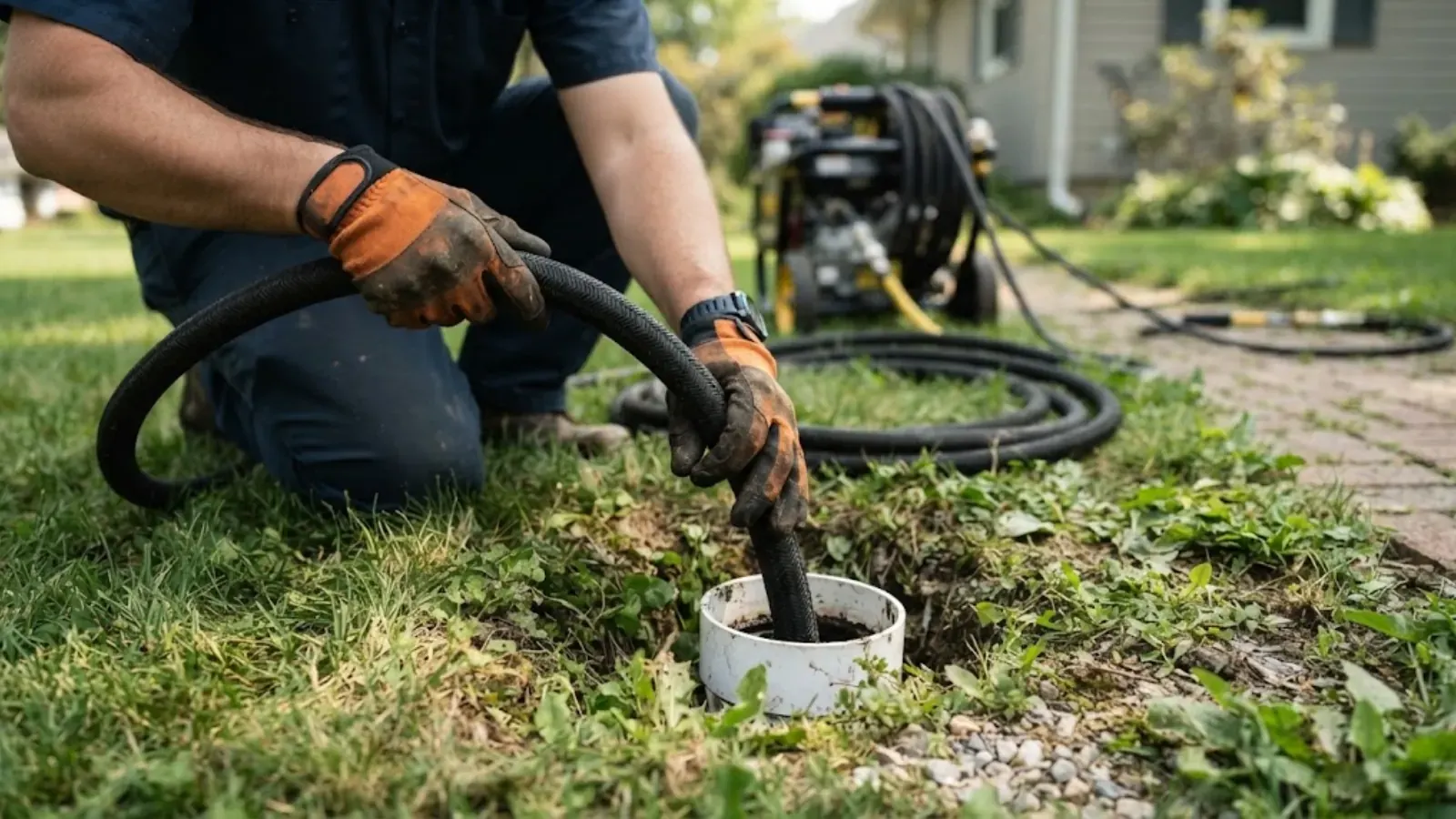
Finding the cleanout
Look for a threaded cap, often black plastic or brass, on a pipe about three or four inches across. Common spots are a basement floor near the foundation wall where the main drain leaves the house, a crawl space, a utility room or an outdoor spot a few feet from the foundation, sometimes under a small cover.
If you cannot find one, check near where the main sewer line exits. Some older houses never got a cleanout. In that case, a plumber may work through a vent stack or a removed toilet, and adding a proper cleanout is worth doing during the visit.
According to the Town of Danvers, so-called flushable wipes do not break down and they clog sewer pipes, which is why they are a common reason a line needs cleaning.
What a cleaning does
Over years, grease, soap film, toilet paper, roots and scale line the pipe wall and shrink its usable diameter. A cleaning scours that buildup away and restores flow. It does not repair a cracked or collapsed pipe, and it is not a fix for a bellied section that holds water.
Think of it as the same idea as an oil change. It removes what the line has collected and gives you a chance to see how the pipe is aging.
How the work is carried out
Open the cleanout
The plumber removes the cap slowly in case pressure or standing water sits behind it, and sets protection on the floor.
Run the cable
A motorized drum cable with a cutting head travels down the line, grinding through roots and soft blockages.
Scour if needed
Where film and grease coat the walls, a high-pressure water jet finishes what the cable started.
Confirm flow
Water is run through the system, and a camera can be sent in afterward to look at the pipe condition.
Cable, jet or camera: which method fits
| Tool | Best for | Limits |
|---|---|---|
| Drum cable with cutter head | Roots, paper and soft stoppages | Leaves a thin film on pipe walls |
| Hydro jetter | Grease, scale and heavy buildup | Needs a sound pipe and clear access |
| Sewer camera | Seeing cracks, sags and offsets | Shows problems, does not clear them |
| Bare snake by hand | Small, quick stoppages | Usually not enough for a main line |
Jetting is its own service with its own best uses. Our page on hydro jetting covers when high-pressure water is the better tool.
How often to schedule it
There is no single interval. Homes with mature trees near the line, older cast iron or clay pipe, or a history of slow drains do better with a regular check. A newer house with plastic pipe and no history may go years between cleanings.
A good rule of thumb: let the line's past behavior decide. If a cleaning pulls out roots or grease each time, shorten the gap. If it comes out nearly clean, stretch it.
Danvers sewers and who owns what
Danvers runs more than 125 miles of gravity sewer main through its Sewer Division, which also repairs the main line. Everything flows on to the South Essex Sewerage District, where the Salem plant does the treating. The pipe running from your house to the town main is generally the homeowner's to keep clear, so ask the Sewer Division where the Town's responsibility ends and yours begins.
Town officials warn that products sold as flushable wipes never break down and end up clogging pipes. Tossing wipes in the trash is the cheapest maintenance step on this page.
Source type: Town of Danvers Sewer Division
Habits that keep a line clear
Wipes in the trash
Flushable wipes snag on roots and rough pipe joints and form dense mats that cable heads struggle with.
Grease in a can
Hot grease liquefies, then cools and hardens in the lateral. Pour it into a can and throw it out.
Roots managed
Roots grow toward moisture at joints. Keep large trees and shrubs away from the sewer path where you can.
Slow drains reported early
Gurgling, slow tubs and sewer odor are cheaper to treat early than after a backup.
Septic homes ask a different question first
Most homes in Middleton rely on septic systems, so a backup there can be a septic tank problem rather than a pipe problem, and a plumber handles the house plumbing, not the tank. A resident of Middleton should answer that question before booking a line cleaning. Whether any Danvers home still uses septic is not something we can say, so check with the Town if you are unsure.
In Peabody, the city posts sanitary sewer overflow notices on its website, and the city belongs to the same South Essex Sewerage District as Danvers. If the whole street is backing up, call the city's notice page first, because your own cleanout will not fix a main that is overloaded.
Getting ready for the visit
Clear a few feet of space around the cleanout and move stored boxes off the floor nearby. Hold off on laundry and long showers beforehand so the line is not full when the cap comes off. Tell the plumber about past slow drains, since that history guides the choice of tool.
When a cleaning is not enough
If the cable keeps hitting the same hard spot, water returns within weeks or the camera shows a crack, offset joint or sag, the pipe itself needs attention. That is a repair question, and we give a firm price before work starts.
Sewer cleanout questions
No. A cleanout is a capped access pipe on the sewer line. A drain is where water enters, such as a floor drain or a sink.
You can, but stand back and be ready for standing sewage behind the cap. Without equipment it is better to leave the cap on.
It clears what is in the pipe now. Roots grow back if the pipe joints let moisture out, so regrowth is a sign to watch.
A careful plumber matches the tool to the pipe. A camera look before aggressive work is smart on fragile clay or cast iron.
Yes. Our emergency line is open overnight and on weekends, and a licensed plumber is sent out.
The Town maintains the main sewer. The pipe from your house to the main is generally yours, so ask the Sewer Division where the boundary is.