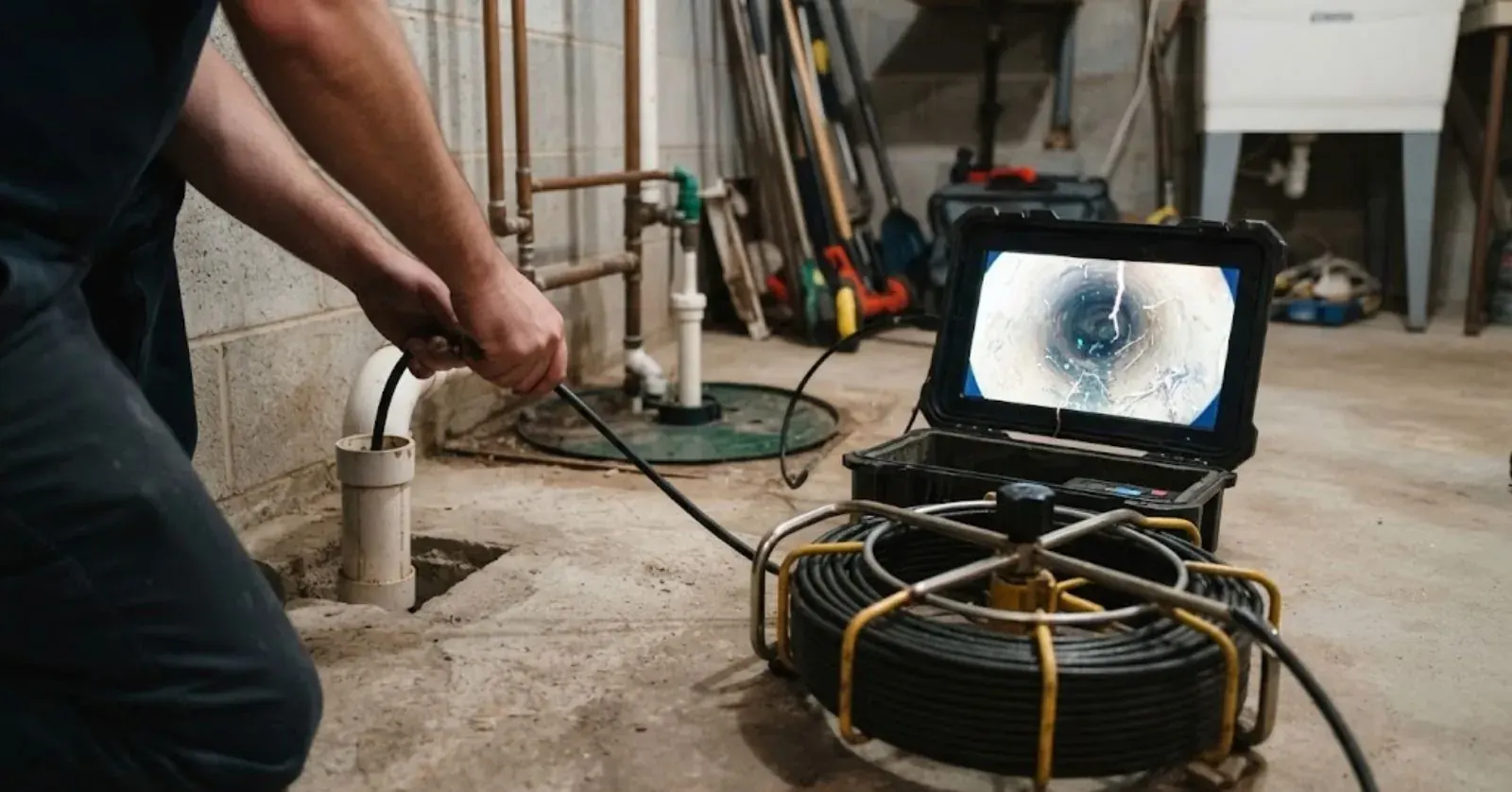
What the Camera Actually Shows
The camera head carries its own lights and sends live video to a monitor. A locator transmitter in the head lets us trace the pipe above ground, so we can say how deep it runs and where it crosses the yard. We pull the camera back slowly and note every joint.
According to the Town of Danvers, its Sewer Division maintains over 125 miles of gravity sewer main, and a camera shows whether a problem sits on your side of the connection.
What shows well: roots entering at joints, hairline and longitudinal cracks, offset or separated joints, sagging stretches where water pools, scale in cast iron and grease coating. These are the things that cause repeat backups.
| Question | Camera answers it | Camera cannot answer it |
|---|---|---|
| Is there a blockage? | Yes, and what it is made of | Why it formed upstream in a branch we did not enter |
| Are roots present? | Yes, with location and density | How fast they will regrow |
| Is the pipe cracked or offset? | Usually yes, with a distance mark | Exact remaining life |
| Is there a belly or sag? | Often yes, from standing water | Whether soil will settle further |
| Is the pipe on town or private land? | The locator shows where the pipe runs | Legal ownership, which comes from the Sewer Division |
| Does a water supply line leak? | No | Supply leaks need a leak detection method |
Buying a Home: Why a Recording Matters
A home inspector looks at the house, not the pipe buried under the lawn. Because 25.4 percent of Danvers housing dates from 1939 or earlier and about 69.5 percent from before 1980, an old lateral is a real possibility on many streets. A recording gives you a bargaining fact, not a hunch.
Footage lets you show a seller, an engineer or another contractor the same picture. It also gives you a baseline, so if the line backs up after you move in, you can compare. Ask for the file and keep it with your closing papers.
If the camera finds trouble, see sewer line repair for how fixes differ. If it finds only buildup, a plan from hydro jetting may be enough.
Roots, Sags and the Slow Backup
Roots look for water and small leaks, and a joint with a hairline gap is an invitation. They grow thicker over seasons, trapping paper and grease until the pipe closes. A single camera pass shows whether you have a few threads or a full mat.
A sag, sometimes called a belly, holds water in a low spot. Waste settles there and the next flush stalls. Cleaning helps for a while, but only a repair restores the slope, which the camera shows by standing water in the footage.
Repeat clogs
The line has been cleared more than once in a year and the same symptoms keep returning.
Gurgling toilets
Air pushed past a partial blockage makes sounds in fixtures that are not in use.
Wet patch over the line
A spot on the lawn that stays wet in dry weather may sit over a crack.
Before a big project
Planting trees, building a patio or driveway work deserves a look at the pipe first.
Buying a house or chasing a mystery backup?
Call us to book a camera inspection and walk away with a recording.
How a Camera Visit Runs
Find the access point
We use an exterior cleanout if there is one, or remove a toilet or open a basement stack when there is not.
Run the camera
We feed the head downstream, mark the footage with distance and note defects as they appear.
Trace and locate
The locator transmitter lets us mark pipe depth and path on the ground for planning.
Review together
We show you the video, explain what matters and say what does not, then give a firm price for any next step.
If the line is full of debris, we may need to clear it before the camera can see the pipe. In that case a short cleaning comes first, which our sewer line cleaning page describes.
Honest Limits of a Camera Inspection
A camera sees only the pipe it reaches. A sharp bend, a collapsed section or a full blockage can stop it, and then we report what we saw up to that point. It cannot look through soil, so it will not tell you what is outside the pipe.
It also does not decide ownership. The Town of Danvers owns and repairs the main line sewer, so if the defect sits in the town main rather than your pipe, the Sewer Division is the right call. Ask where responsibility ends at your address.
Seasons, Storms and the Right Time to Look
A line often behaves best in dry weather and worst after a long rain. A camera pass is still useful in storm season, but high groundwater can mask small leaks and make the pipe harder to read. If your concern is a backup in storms, tell us so we can watch for infiltration at joints.
The Town prohibits sump pumps, roof downspouts and exterior foundation drains from connecting to the building sewer. If the camera sees clear groundwater flowing in, or you have a sump discharging inside, we flag it. Our sump pump page covers alternatives.
What Drives The Price
An inspection is priced by how much pipe there is and how hard it is to reach. We tell you the number before the camera goes in.
Insurance rarely pays for an inspection by itself, though it may help document a claim after a backup. A pre-purchase recording is a negotiating tool.
Want a firm price for a camera visit? Call (855) 575-2890
Sewer Inspection Questions Before You Book
It shows pipe material, joints, roots, cracks, offsets, sags, scale and blockages, all with a distance mark. It does not show leaks in water supply lines or the soil outside the pipe.
It is a smart step, especially on an older home. A home inspector does not see the buried line. A recording helps you negotiate repairs or credits and gives you a baseline.
Yes. Our 24/7 line takes backup calls at any hour. If water is rising, stop using drains and call. We use the camera afterward to find the cause.
Yes, you can ask for the recording. Keep it with your house records, because it helps with sales, claims and future comparisons.
It can show where your drain line goes. A tank is a separate question. If you are unsure whether your property has one, ask the Board of Health and your deed paperwork.
There is no single rule. A line with a history of roots may deserve a look every year or two. A newer, trouble-free line can go much longer. A camera pass is wise after any repeat backup.