Sewage Is Coming Up: The First Ten Minutes
Do this while the plumber is on the way
- Stop using every drain and toilet, including the washer and dishwasher.
- Keep children and pets away from standing sewage, which carries bacteria.
- Open a window if sewer odor is strong, and leave the house if you feel dizzy or ill.
- Wear rubber boots and gloves if you must cross a wet floor.
- Lift valuables off the floor and photograph the damage for your insurer.
A backup is not always a break. Many are clogs, and a camera tells us which. If it is only a clog, see our sewer line cleaning page.
Reading the Backup: One Fixture or Every Drain
Where the water shows up tells us where the trouble sits. If only a second-floor bathroom is slow, the problem is probably in that branch. When the lowest drain in the house gurgles or fills first, the blockage is usually in the main lateral between the house and the street.
According to 248 CMR 3.05, a permit must be issued before plumbing is installed, altered, removed, replaced or repaired, and permits go only to licensed plumbers.
Water that returns every few weeks after a cable visit hints at damage, such as roots through a joint, a section that sags and holds water, or a collapsed segment. A single clear-out that holds for a year points to a plain clog. We watch the pattern before recommending anything big.
Repair, Replace or Go Trenchless: Choosing the Fix
The right method depends on what the camera shows and where the pipe sits. A short break near the foundation is a very different job from a line that is cracked along most of its length under a driveway. In New England the ground can freeze 48 inches down, so exterior digging also has to work around cold weather.
| Method | Fits when | Trade-offs |
|---|---|---|
| Spot repair | One broken or offset section, pipe otherwise sound | Needs a trench at that spot. Smallest job, but old pipe remains on both sides |
| Full replacement by open trench | Pipe cracked, sagging or collapsed over long runs | Most disruptive to lawns and paving. Gives a new pipe and a new slope |
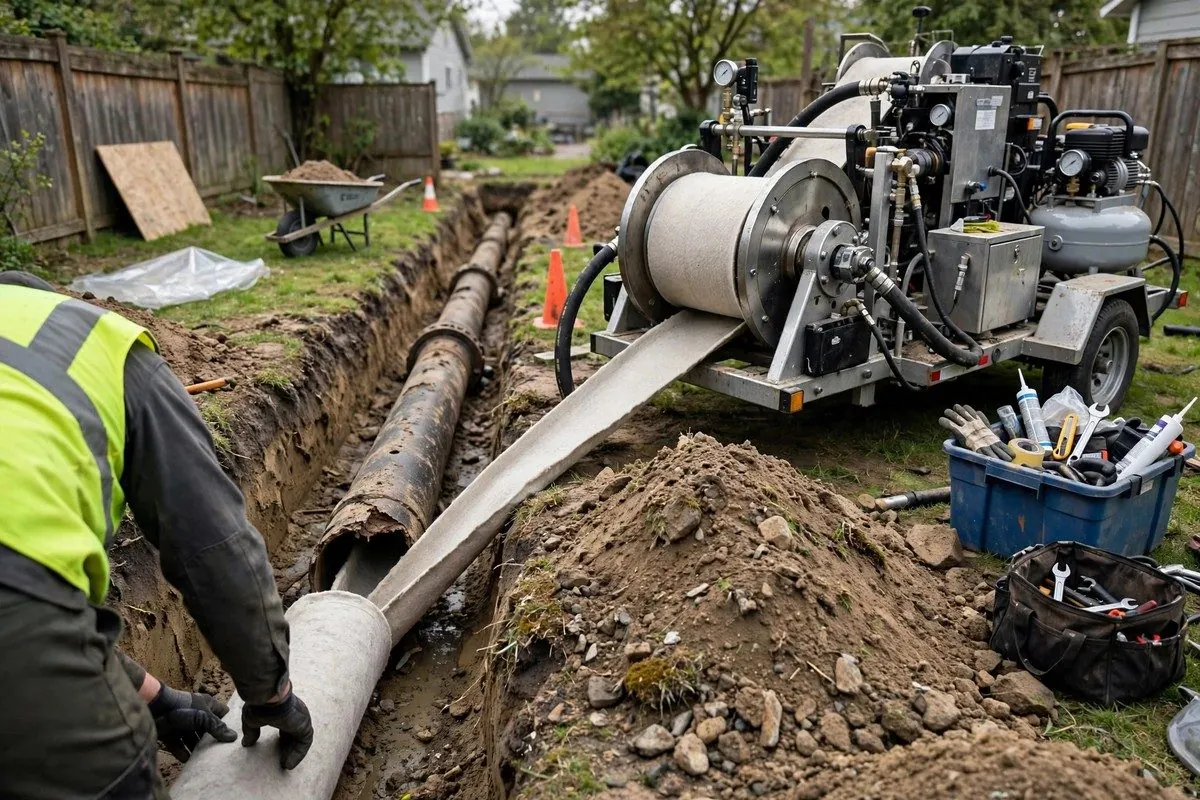
| Pipe lining (cured in place) | Cracks and root entry in pipe that is still round and aligned | Cannot fix a collapsed or badly sagging pipe, and it shrinks the diameter slightly |
| Pipe bursting | Failing pipe with a straight path | Needs entry and exit pits, and nearby utilities must be located first |
| Cleaning only | Blockage with no damage found | Does not repair anything, may need repeating |
No method is best everywhere. We explain why one suits your pipe and what we cannot promise. The camera pass behind that advice is covered under sewer inspection.
Not sure if it is a clog or a break?
Call the 24/7 line. We camera the line and tell you which, before anything gets dug up.
Whose Pipe Is It: The Town Main and Your Lateral
The Town of Danvers Sewer Division maintains more than 125 miles of gravity sewer main, and the Town owns and repairs the main line sewer. Sewage then travels to the South Essex Sewerage District and is treated at its Salem plant. Your responsibility starts at the pipe serving your property.
Where exactly the town's pipe ends and yours begins can vary by street. Before we dig or quote a big job, ask the Sewer Division where responsibility changes at your address. If our camera shows the problem sits in the town main, you call the town and we step back, which can save you real money.
Backwater Valves and Basements That Sit Too Low
A backwater valve is a one-way gate in the sewer line that blocks sewage from flowing backward into your home. Danvers requires one where basement sewage discharge sits below the rim elevation of the closest public sewer manhole. The valve goes in before the sewer connection leaves the building, and the Town page cites state plumbing code 248 CMR 10.00.
If your basement bathroom or laundry sits low and you have ever had a backup in a storm, ask whether your fixtures fall under that rule. Heavy rain can overload the system, and the Town lists sewer backflow prevention as a recommended action. An existing valve needs periodic cleaning to work, and we can check yours.
Septic or Sewer: The Question to Ask Before Anyone Digs
Whether any homes in Danvers still rely on septic is not something we can confirm. So the honest move is to ask yourself, your deed paperwork or the Board of Health. If your house has a tank, the plumber handles the pipes in your home and the line to the tank, not the tank itself.
A septic backup can look exactly like a sewer clog. That is why the first question on every backup call is whether there is a tank in the yard. If there is, a septic pumper is called before any pipe repair. If you are on town sewer, we continue with the camera.
Slow drains throughout
Every fixture drains slowly at once, which often points to the main rather than a single branch.
Sewer odor outdoors
A smell near the yard or cleanout can mean a crack or a tank problem.
Sunken or soggy lawn
A strip of lawn that sinks or stays wet over the line suggests a break below.
Frequent roots
Needing the line cleared every season signals root entry through a bad joint.
What Failing Pipe Looks Like on Older Streets
About 25.4 percent of Danvers homes date from 1939 or earlier, and about 69.5 percent from before 1980. Older laterals may be clay tile, cast iron or fiber conduit, none of which lasts forever. Joints shift, roots find gaps and the pipe can sag where soil settled.
A newer house is not immune. Poor bedding or a crushed section during construction can break a modern plastic line. The camera tells the story, and we show you the footage so you can see what we see.
What Drives The Price
Sewer repair prices depend heavily on what is wrong and where. A firm number is given after the camera pass and before any digging starts.
Homeowners policies often exclude pipe wear and tear and may cover only sudden water damage. A separate sewer backup endorsement is worth asking about.
Want a firm number for your sewer line? Call (855) 575-2890
Rain, Sump Pumps and the Town Sewer
The Town prohibits connecting sump pumps to the sewer, with no grandfathering. Roof downspouts, exterior foundation drains and area drains also may not tie into the building sewer. Extra water in the sanitary line raises the odds of a backup for everyone downstream.
If a repair crew finds a stormwater connection, we will recommend fixing it as part of the job. See our sump pump page for ways to move water outside. Peabody shares the same sewerage district, so the same advice applies on the Peabody side of the line.
Sewer Repair Questions From Homeowners
A clog clears and stays clear. A break returns, often within weeks, and shows roots, sag or cracks on camera. Only a camera inspection can tell them apart reliably.
Yes. Our 24/7 line dispatches a licensed plumber for sewage backups at any hour. Stop water use, protect the floor and call while you wait.
It fixes the pipe from inside, or replaces it with minimal digging. Lining and pipe bursting are common forms. It works when the pipe is still continuous enough, and not for every collapsed line.
The Town owns and repairs the main line sewer. Your side is the pipe serving your property. Ask the Sewer Division where responsibility changes at your address.
We handle the pipes in the house and the line leading to the tank, but not the tank. We cannot confirm how many Danvers homes use septic, so ask whether yours has one.
The Town requires one where basement sewage discharge is lower than the rim of the nearest public manhole. We can check your fixtures against that rule and inspect any existing valve.
Under state rules a permit comes before plumbing work is altered, replaced or repaired, and permits go only to licensed plumbers. A minor repair like clearing a clog does not need a permit. Ask Danvers Inspectional Services about your job.