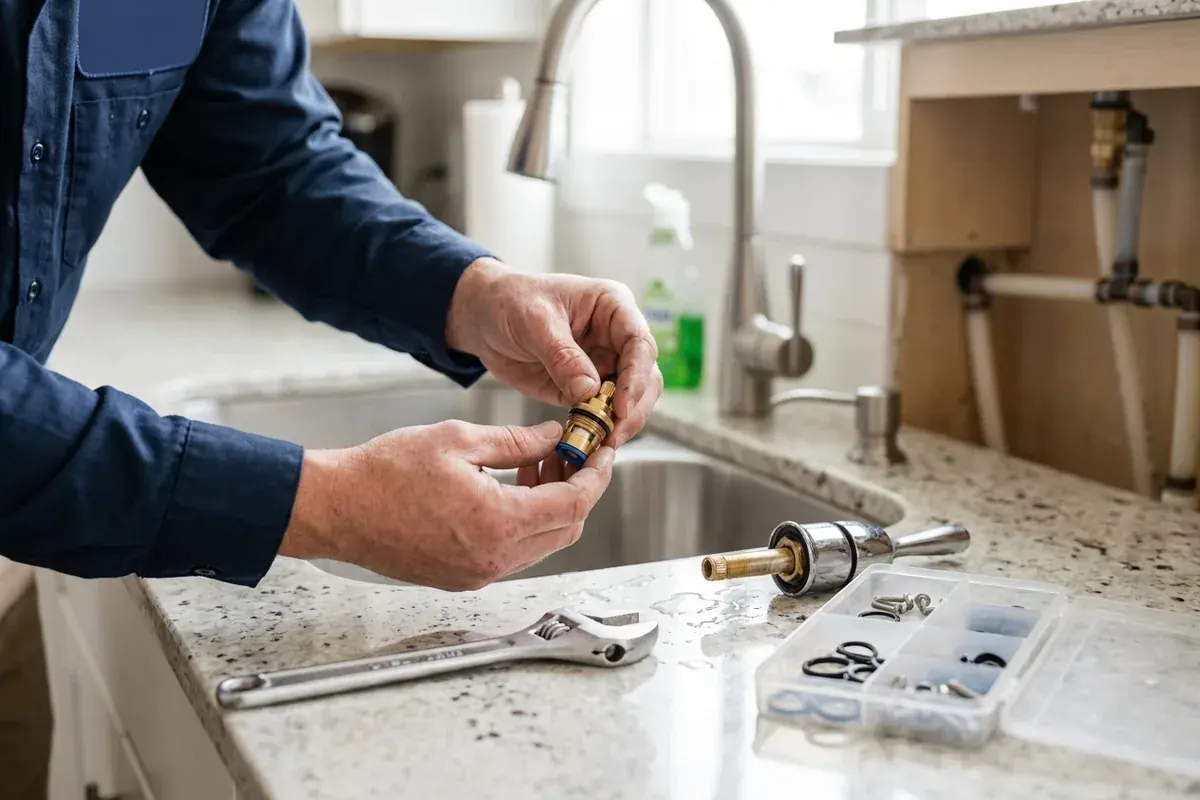
First, Work Out Which Drip You Have
Drip from the shower head
The valve is not sealing when closed. This points to the cartridge, the stem washer or the seat inside the wall.
Water around the handle
Water seeping behind the trim ring means a worn O-ring or a loose packing nut on the stem.
Drip from the tub spout
On a tub and shower combo, the diverter may be failing, or the same valve problem is leaking into the spout.
Hot or cold only
A drip only when the handle sits on hot suggests a worn hot-side seat or a damaged cartridge half.
Tools And Prep Before You Open The Wall Trim
Gather a Phillips and flat screwdriver, an adjustable wrench, needle-nose pliers, a hex key set, plumber's grease and a rag to stuff the drain so no screw goes down it. Take a photo of the handle before you remove it, because trim order is easy to forget.
Under the Massachusetts permit standard, fixing a leaky faucet is a minor repair, but replacing or relocating a faucet is not minor and needs a permit.
Find the fixture shutoff if the bathroom has one. If not, close the main shutoff and open a lower faucet to drain the pipes. Then turn the shower handle on to bleed off the last of the pressure.
Which Valve Do You Have?
| Valve style | How to recognize it | What usually wears | Typical fix |
|---|---|---|---|
| Single-handle cartridge | One lever that pushes, pulls and rotates | Cartridge seals or O-rings | Replace the cartridge with an exact match |
| Two-handle compression | Separate hot and cold knobs that screw down | Rubber stem washer, brass seat | Replace the washer, resurface or replace the seat |
| Two-handle cartridge | Separate quarter-turn knobs | Ceramic disc cartridge | Replace the cartridge for that side |
| Pressure-balancing valve | Single handle with a rotation limit stop | Balance spool and seals | Replace the cartridge or spool kit |
| Diverter valve | A tub spout lift knob or a handle that sends water up | Seal or gate inside the diverter | Replace the diverter or its seal |
The Cartridge Repair, Step By Step
Remove the handle
Pry off the cap, back out the set screw with the hex key and slide the handle and escutcheon plate free.
Pull the retaining clip or nut
Most cartridges are held by a brass clip or a bonnet nut. Take it out slowly and note which way the cartridge faces.
Extract the cartridge
Grip the stem with pliers and wiggle it straight out. If it fights you, a cartridge puller tool prevents cracked housings.
Install the match
Take the old cartridge to a plumbing supply counter. Grease the O-rings, seat the new one in the same orientation and rebuild the trim.
If You Have Old Compression Stems
Replace the washer
Unscrew the stem, remove the screw at its tip and swap the rubber washer for one of the same size and shape. A beveled washer will not seal in a flat-seat valve, so bring the old one with you.
Check the seat
Shine a flashlight into the valve body. A seat that is scored or pitted will chew through new washers within weeks, and a seat wrench can resurface or remove it. If the seat is stuck or the body is soldered into the wall, stop there.
Danvers Water And Your Shower Hardware
Danvers water comes mostly from Middleton Pond and is treated with pH adjustment and phosphates for corrosion control. The Town's own report notes that white scaling or hard deposits on faucets and shower heads may come from calcium carbonate. Scale grabs cartridge O-rings and wears them, so wipe mineral crust off the valve body before you reassemble.
The Town does not publish a hardness number. Ask the Water Division for the annual water quality report, or test your own tap, and use the result to decide whether a whole-house treatment step is worth a conversation.
State rules also matter. Massachusetts treats fixing a leaky faucet as minor work with no permit, but replacing or relocating the faucet is not minor and needs a permit issued to a licensed plumber.
Source type: Town of Danvers water supply page and Massachusetts plumbing permit guidance
When To Stop And Call A Plumber
Signs the job is bigger than a cartridge
- The handle will not come off or the cartridge will not budge after steady pulling.
- The valve seat is corroded and the body is soldered rather than threaded.
- Water stains show on the ceiling below or the wall feels soft around the tub.
- You replaced the cartridge and the drip is still there.
- The shutoff valves do not hold, so the water cannot be turned off.
A drip that keeps going after a good repair may mean the leak is inside the wall, not at the valve. Our faucet repair team handles the swap and the rebuild, and if water stains tell you the source is hidden, leak detection can trace it without tearing open tile.
Neighbors in nearby towns ask the same questions. In Middleton, the water comes from the same Danvers system, so the scale advice above applies there too. In Topsfield, the town's own wells carry high iron and manganese, so ask the water department for its report if fixtures stain.
Shower Faucet FAQ
Usually a worn seal inside the valve, either the cartridge or a rubber washer. Mineral scale can also keep a seat from closing fully.
Yes. A steady drip wastes water and can leave rust or mineral streaks in the tub, and the valve damage only grows with time.
Look for a brand name or model number on the trim plate, or take the old cartridge to a plumbing supply counter. A near match often leaks.
Massachusetts counts repairing a leaky faucet as minor, so no permit is needed. Replacing or relocating the faucet is not minor, so contact Danvers Inspectional Services at 1 Sylvan Street before that kind of work.
Do not force it. Close the main shutoff instead, and call a plumber to replace the failed fixture stop.
It can. Scale roughens seats and clings to rubber seals, which is why Danvers households that see white crust on fixtures sometimes replace cartridges more often.