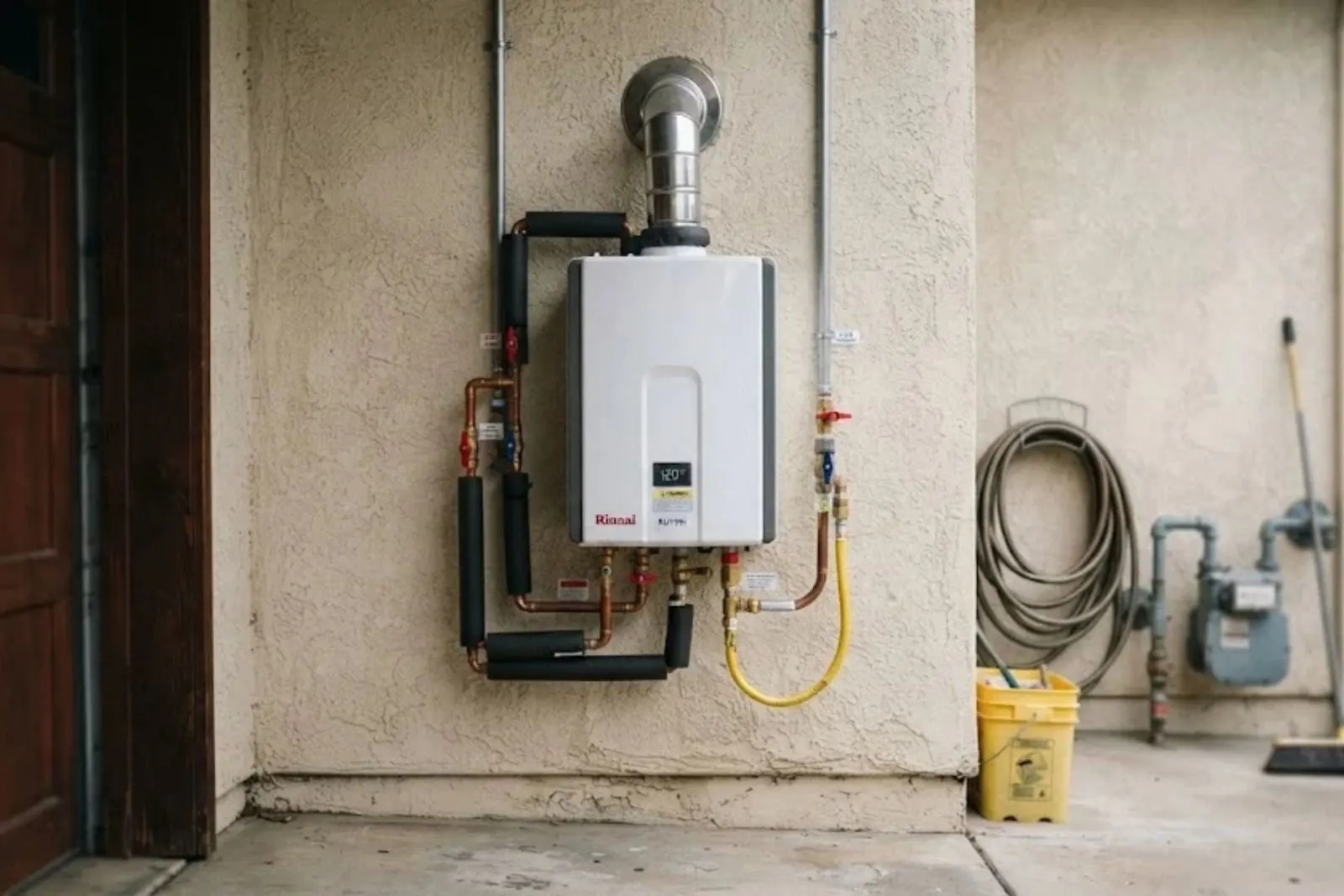
The cold water sandwich
Here is what happens. You shut a tap off briefly, the heater stops firing, and the hot water already in the pipe keeps moving. When you turn the tap back on, a slug of cooled water arrives before the unit relights and catches up.
According to the Danvers annual water quality report, white scaling on fixtures may come from calcium carbonate, the same kind of deposit that can coat a heat exchanger.
You cannot fully remove this, since the heater needs a moment to detect flow and ignite. Fewer on-off cycles help, as does a slightly higher temperature setting so the cooled slug is warmer. Where a long pipe run feeds a far bathroom, a small recirculation setup or buffer tank is the real fix.
Reading error codes without the manual
Every brand uses its own numbers, and the manual for your exact model is the final word. The codes do fall into families, though, and knowing the family tells you whether to grab a screwdriver or the phone.
| Family | What it means | Safe owner check | Call a plumber if |
|---|---|---|---|
| Ignition or flame failure | Burner did not light or lost flame | Gas valve open, other gas appliances working | Code returns after a reset |
| Exhaust or vent fault | Air in or flue out is restricted | Look outside for snow, nests or debris at the terminal | Terminal is clear and code stays |
| Water flow fault | Too little water or sensor reading wrong | Clean aerators and the inlet filter screen | Flow is fine at taps but code stays |
| Overheat or high limit | Water got too hot inside the unit | Turn off, wait, power cycle once | It trips more than once |
| Condensate or leak sensor | Drain is blocked or water is where it should not be | Look for drips and a kinked drain tube | You see water at the cabinet |
| Temperature sensor fault | Thermistor gives odd readings | Power cycle once | Any repeat |
Scale: the slow problem that causes the fast ones
A tankless unit heats water as it passes through a narrow copper or stainless heat exchanger. Dissolved calcium carbonate drops out of hot water and coats those passages. The coating restricts flow, makes the unit run hotter than it should and triggers overheat or flow codes.
Signs show up first as lower pressure at hot taps, a longer wait for warm water and temperatures that swing. Water that is fine in a shower can still leave a heat exchanger scaling up over a few seasons.
How a flush is done
Shut it down
Turn off power and gas, then close the isolation valves on the hot and cold lines feeding the unit.
Hook up the hoses
Connect hoses from a small pump to the service ports, with the return hose running to a bucket holding the descaling solution.
Circulate
Run the solution through the heat exchanger for the time the manufacturer lists. White vinegar is common, though the manual may name a specific product.
Rinse and restore
Flush with clean water, clean the inlet screen, reopen the valves, restore power and gas, and test at a tap.
No isolation valves means no practical flush. An installer can add them, and that is usually worth doing on any unit that lacks them.
Low flow and the minimum activation rate
Tankless heaters fire only when enough water is moving, typically a fraction of a gallon per minute. A nearly closed single-lever faucet, a clogged aerator or a partly closed supply valve can drop the flow below that line, and the burner shuts off. Check each fixture on the line before blaming the heater.
Danvers water and your heat exchanger
Danvers water comes mainly from Middleton Pond, treated at the Vernon C. Russell Water Treatment Plant, with two supplemental wells off Route 114. The town report notes that white deposits on faucets and shower heads may be calcium carbonate.
The town does not publish a hardness number, so do not guess a flush schedule from a figure you found online. Request the annual water quality report from the Water Division, run a tap test of your own, and watch your aerators: how fast scale builds there is a fair preview of what the heat exchanger sees.
Source type: Town of Danvers DPW Water Division annual report
Same system, different towns
Our neighbors in Middleton are on the same Danvers and Middleton water system, so the scale advice above applies directly. Some households there use a private well, though, and state well guidance says to test for hardness, iron and manganese among other items.
Results like that decide the flush schedule. Across the city line, Beverly is served by the Salem and Beverly Water Supply Board, which adjusts pH for corrosion control, so ask that board for its report.
A short checklist before you call
Try these first
Most of these take five minutes and need no tools.
- Confirm the gas shutoff and the power switch are both on.
- Open one hot tap fully and see whether the unit fires.
- Unscrew and rinse the aerators on the faucets with trouble.
- Check the outdoor vent terminal for blockage.
- Write down the code and the model number.
If the code returns after a reset, or you smell gas or see water at the cabinet, stop and call. A licensed plumber handles the gas and venting work. Our team can book a visit through water heater repair for faults that need parts.
When it is time to stop troubleshooting
Repeated ignition faults, a heat exchanger that leaks, or flue gas smell all belong with a licensed plumber. Scale that survives a proper flush can mean the exchanger is past saving. We give a firm price before work begins, so you can weigh a part against a new unit.
Tankless troubleshooting questions
Below its minimum activation rate the unit may not fire, or it fires at low output. Open the hot tap further and clean the aerator.
Once a year is the common guidance, and more often if water leaves heavy scale on fixtures. Your manual and local water quality set the real interval.
Power cycling once is fine. If the same code returns, the cause is still there, and repeated resets on a gas unit are not a good idea.
The outdoor terminal should be clear of leaves, nests and snow. Internal vent work on a gas unit is for a licensed plumber.
Yes. A cold shower at midnight is a fair reason to call, and the emergency line is open around the clock.
The town publishes no hardness number, so nobody can answer that from a map. The Water Division report and a simple tap test give you a basis, and white scaling on fixtures means a yearly flush is a sensible default.