The rule that shapes the design
Under the Danvers sewer regulations, roof downspouts, exterior foundation drains, area drains and sump pumps cannot tie into the building sewer, and clear groundwater has no place in the sanitary system. Older homes that once drained a pit into a floor drain or a laundry sink line have to be corrected.
According to the Danvers Sewer Regulations (Section III), roof downspouts, exterior foundation drains, area drains and sump pumps may not connect to the building sewer.
The reason is capacity. The public sewer was sized for household wastewater, and sump flow during a storm adds to the load at the pump stations and treatment plant.
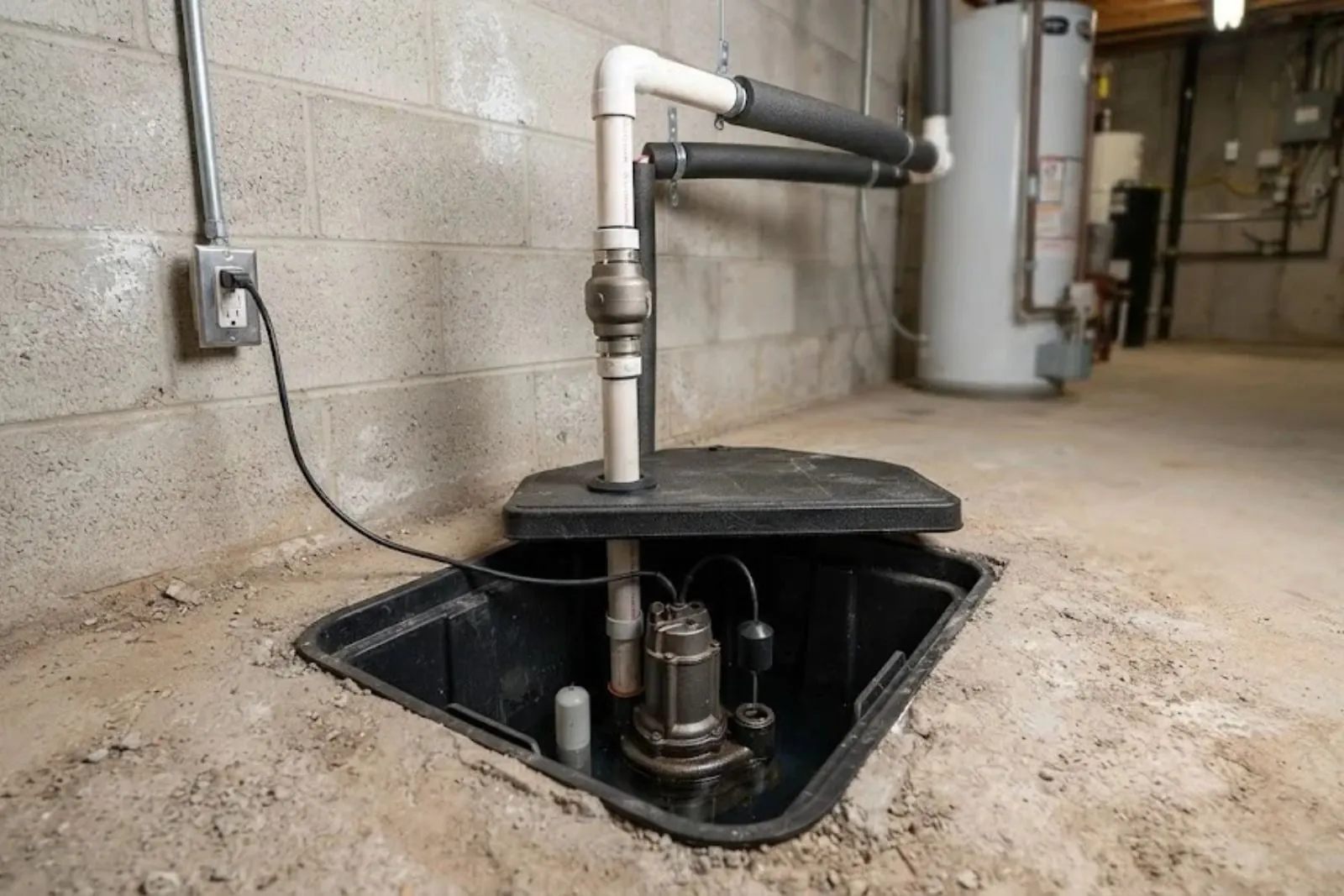
What goes into a sump system
- The pit or basin, a plastic or fiberglass liner set into the slab, usually with a bed of gravel under it.
- The pump, either submersible (sits in the pit) or pedestal (motor mounted above).
- The float switch, which starts the pump as the water rises.
- The check valve, which stops water in the discharge pipe from falling back into the pit.
- The discharge pipe that carries water out through the wall or rim joist.
- A sealed lid, which keeps humidity, odors and soil gases such as radon from entering the room.
How the installation goes
Find the low point
The pit goes where water naturally collects, often along the footing drain or at the lowest corner of the slab.
Cut and dig
A section of concrete is cut out, soil is dug to the liner depth and gravel is laid so water can enter from below.
Set the liner and pump
The liner is leveled, the pump sits on a flat base, the float has room to swing and a drilled weep hole prevents air lock.
Pipe, seal and test
Pipe runs with a check valve to the outside, the slab is patched around the liner, and the pit is filled with water to confirm cycling.
Where the water goes: discharge options
| Route | Works when | Watch for |
|---|---|---|
| Out the rim joist to a splash block | Yard slopes away from the house | Water returning along the foundation |
| Buried pipe to a lawn outlet | Space and slope are available | Freeze-ups at the outlet in winter |
| Pop-up emitter on a buried line | You want a hidden outlet | Debris blocking the emitter lid |
| Extension to a storm drain or dry well | Allowed by the property and the town | Check with the town first |
| Into a floor drain or sewer line | Never in Danvers | Prohibited, with no grandfathering |
| Toward a neighbor or the street edge | Rarely | Icy sidewalks and disputes |
Massachusetts uses a 48-inch frost line in its building code tables, and a discharge line that holds water above that depth can freeze. The pipe should pitch continuously downhill to its outlet so it drains empty between cycles.
Check valve and the water-hammer thump
Without a check valve the water standing in the pipe falls back into the pit and makes the pump work twice. With one, you may hear a small thump when the pump stops. Quiet-closing models soften it, and a drilled relief hole above the pump handles air lock.
Battery backup for storm outages
Big storms knock out power exactly when the pit is filling. A second pump powered by a deep-cycle battery, or a water-powered backup where pressure allows, covers that gap. The backup pump sits a little higher than the main one so it starts only if the first fails or is overwhelmed.
A battery needs a charger and a test now and then. Add a high-water alarm so you hear about a failure before the carpet gets wet.
Yearly upkeep that prevents a bad night
Before the wet season, pour a bucket of water into the pit and watch the pump start, run and shut off. Lift the float to confirm it moves freely, clear the outdoor outlet of leaves and ice, and listen for a grinding motor. Five minutes of testing catches most failures.
Safety Checklist Before You Dig In
- Unplug the pump before you touch the pit, the float or the discharge line.
- Keep extension cords and power strips out of standing water.
- Do not reach into a pit that is full of water while the pump is still plugged in.
- Test the high-water alarm and the battery backup, if you have one, before storm season.
- Leave any wiring change or new outlet to a licensed professional.
Danvers rules and flood context
The ban covers every property, old or new, and Section III of the Sewer Regulations puts sump pumps in the same group as downspouts and exterior foundation drains. A separate rule asks for a backwater valve on houses whose basement plumbing sits lower than the nearest public manhole rim.
Flooding is rated high frequency and serious in town hazard planning, with five repetitive-loss residential structures and FEMA zone AE along Beaver Brook and Crane River. If your house sits near those brooks, plan for a stronger pump and a backup, and ask Danvers Inspectional Services about anything touching drainage.
Source type: Town of Danvers Sewer Regulations and hazard mitigation plan
Neighboring yards, same storms
Middleton's hazard plan records about 12 inches of standing water on Boston Street in June 2017 and flooding on Village Road and Maple Street in 2018. A flooded yard stresses sump pumps and septic fields at once, a point worth remembering for Middleton homes. In Topsfield, the Ipswich River stayed above flood stage about 20 days in March 2010, which shows how long a pump may need to keep running.
When drainage needs more than a pump
If water enters faster than any pump can lift it, or the walls and floor seep all over, the pit alone will not solve it. An interior drain channel along the footing leads to the pit. That wider scope falls under basement waterproofing, and we give a firm price before any work starts.
Sump pump installation questions
Many pumps run seven to ten years, less if they cycle often. A pump that runs for years without a test is a risk.
Submersible pumps are quieter and sit hidden in the pit. Pedestal pumps are easier to reach for service but louder and more exposed.
In Danvers, no. Sump pumps may not connect to the building sewer or any drain that leads to it.
Massachusetts requires a permit before plumbing work is installed or altered. Ask Danvers Inspectional Services if you are unsure how the rule applies.
Call our 24/7 line. We book same-day visits when we can, and shutting off power to wet outlets comes first.
No. The check valve is on the sump discharge. A backwater valve sits on the building sewer and stops main sewer flow from entering.