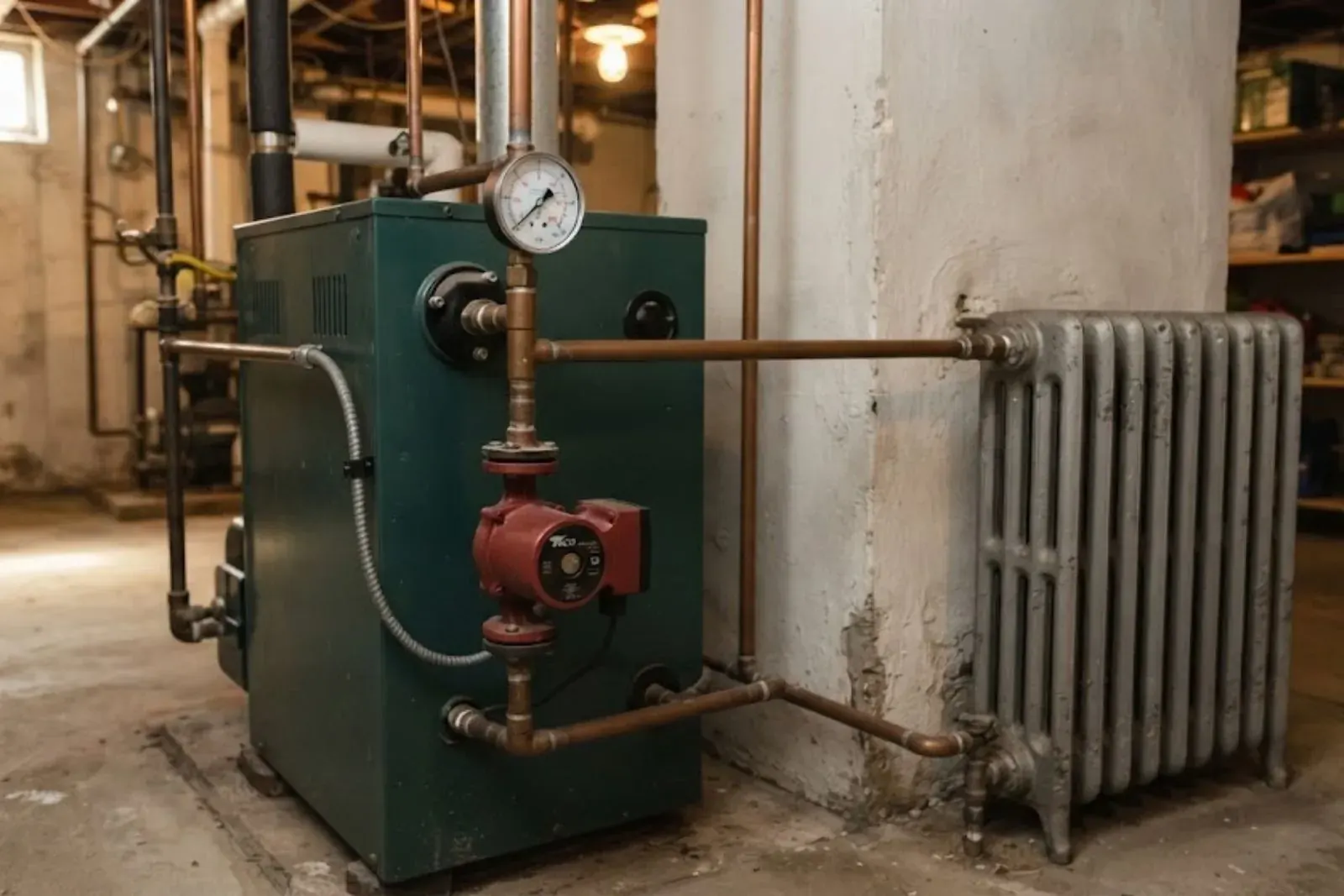
Cold House: What to Check Before the Call
Quick checks when the heat is out
Do these safely. If you smell gas or see soot, leave the house and call your gas utility from outside.
- Confirm the thermostat is set to heat and above room temperature.
- Check the boiler switch and the breaker, since many boilers have a nearby emergency switch.
- Look at the pressure gauge. A reading near zero means the system has lost water, and a very high reading points to an expansion problem.
- Look for puddles under the boiler, at pipe joints and under radiators.
- Bleed air from a cold radiator only if you know how and the system is cool.
Tell the dispatcher what you see: leak, low pressure, noise or cold radiators. Shut off the water feed to the boiler if it is leaking heavily. Leave the burner and fuel side alone.
According to Massachusetts standards, only a master or journeyman plumber licensed by the Board of State Examiners of Plumbers and Gas Fitters may do plumbing work on a boiler system.
A Plain Statement of What We Cover
We are a plumbing company. We repair the water side of a heating system: leaks, relief valves, pressure, expansion tanks, circulator pumps, zone valves, air in the lines and the piping around the boiler. We do not claim to service burners, and we make no brand claims about boilers.
Heating work that involves oil burners may need a separate licensed tradesperson. Ask when you book, and the dispatcher will say whether your issue is on our side of the line. That saves a wasted visit.
Hot-Water Versus Steam in Older Homes
About 43.5 percent of Danvers housing was built before 1960, and about 25.4 percent in 1939 or earlier, so some homes carry original steam systems or cast iron radiators converted to hot water. The two systems fail differently, and knowing which one you have helps the plumber.
| Feature | Hot-water (hydronic) | Steam | Common plumbing issue |
|---|---|---|---|
| Heat carrier | Hot water pumped through pipes | Steam rising to radiators | Water level and leaks |
| Pressure | Gauge typically reads in a low steady range | Very low pressure, near atmospheric | High pressure on a steam boiler is a warning |
| Key parts | Circulator pump, expansion tank, zone valves | Sight glass, low water cutoff, radiator vents | Pump failure, waterlogged tank, stuck vents |
| Noise | Gurgling points to air | Banging points to trapped water in pipes | Pitch, air or low water |
| Radiator behavior | Cold at the top means air | Uneven heating means failed vents | Bleeding or vent replacement |
Do not guess at a steam system. Pressure that is too high is dangerous, and the sight glass and low water cutoff exist for a reason. Call before you add water to a steam boiler.
Leaks, Pressure and the Expansion Tank
A hot-water boiler is a closed loop. When water heats, it expands, and the expansion tank holds that extra volume with an air cushion behind a rubber diaphragm. If the diaphragm fails, the tank fills with water and the pressure climbs every time the boiler fires, until the relief valve opens and drips.
A dripping relief valve is a symptom, not the problem. Replacing the valve without checking the tank usually brings the drip back. We test the tank, check the fill valve and look at the gauge, which tells us whether the fault is the tank, an auto-fill valve or a leak that is letting water out.
No heat and a cold house?
Call the 24/7 line. We will tell you if the problem is plumbing, and what to ask for if it is not.
Circulator Pumps, Zone Valves and Cold Radiators
If the boiler fires but only some rooms warm up, the water is not moving where it should. A failed circulator pump hums or sits silent while the pipes stay cool. A zone valve stuck closed starves one loop while others work. Air trapped in baseboard produces gurgling and heat that fades at the far end of a run.
Read the system
We check the gauge, the thermostat call, the pump and the valve positions.
Isolate the fault
Touching pipes before and after the pump and each zone valve shows where flow stops.
Fix the water side
Swap the pump, replace a zone valve or tank, purge air, or repair a leaking joint.
Refill and test
We restore the correct pressure, run the system and confirm that every zone heats.
Old black iron pipe and cast iron radiators can also corrode and weep at fittings. A small leak that you wipe up each week is still a leak, and a worn section may be a sign for repiping the run. For hot water on tap, the boiler may feed an indirect tank, and tank problems are covered under water heater repair.
When the Problem Is Not Plumbing
Burner that will not light, soot, odd smells, ignition faults and fuel supply issues are not plumbing. Oil burners may need a separate licensed tradesperson, and gas appliance work has its own rules. If you smell gas, leave and call National Grid from outside. We would rather tell you that on the phone than bring the wrong truck.
What Drives The Price Of Boiler Plumbing Repair
A tank swap and a full zone rebuild are different jobs. We give a firm figure after seeing the system and before work starts.
Heating failures from wear are usually not covered, though sudden pipe bursts from a frozen system may be. Check with your insurer.
Want a firm number for your system? Call (855) 575-2890
Frozen Boiler Lines and Winter Cold Snaps
If heat fails during a hard freeze, the pipes in the house are at risk within a day or so. Open cabinets under sinks, keep interior doors open, and call quickly. A frozen split pipe becomes a burst pipe repair problem, and our plumbers handle that side too.
Boiler Questions Answered
Yes. The 24/7 line is staffed all night and on weekends. We dispatch a licensed plumber the same day when available for leaks, loss of pressure, dead circulators and similar plumbing faults.
Oil burner work may need a separate licensed tradesperson. Ask when you book, and the dispatcher will tell you whether your problem is on the plumbing side.
Usually a waterlogged expansion tank or a stuck fill valve. If the relief valve is already dripping, call. Do not close it off.
Air is trapped. Bleeding the radiator can help on a hot-water system. If many rooms are cold, the circulator or a zone valve may be failing.
A steady leak, rising puddle or a pressure gauge dropping to zero is urgent. Shut the feed valve and call. A tiny weep can wait for a scheduled visit.
We handle the plumbing side such as leaks, vents and piping. Steam systems are sensitive, so describe what you have when you call and we will say whether it fits.
Look for a metal unit in the basement or utility room with pipes running to radiators or baseboard. A furnace blows air through ducts, while a boiler heats water or makes steam.