Read the pattern before you touch anything
| What you notice | Most likely source | Where to look |
|---|---|---|
| Wet only after heavy rain or snowmelt | Groundwater | Wall base, floor cracks, window wells |
| Wet during dry weather and getting worse | Plumbing leak | Heater, washer hoses, pipes overhead |
| Gray or dark water with a sewer smell | Drain or sewer backup | Floor drain, laundry standing pipe |
| Damp patch that stays in one spot | Slow pipe leak or condensation | Under a bath above, along cold pipes |
| Water rising from the sump pit edge | Pump failure or overwhelmed pit | Pit, float switch, discharge line |
| Wet slab with a rising meter | Leak in or under the slab | Hot water line, supply to the house |
Four tests you can run in one afternoon
Check the water meter
Turn off every faucet and appliance, then watch the meter dial or low-flow indicator for ten minutes. Movement means water is going somewhere you cannot see.
Try the foil test
Tape a square of aluminum foil flat to the damp wall or floor and leave it a day. Moisture on the underside means it is rising from the ground. Moisture on top means humid air is condensing.
Match it to the weather
Write down when water appears. A pattern tied to storms points to groundwater and drainage, not pipes.
Smell and look at the water
Clear and odorless is normal for supply or groundwater. Cloudy, gray or foul water is wastewater, and you should stay out of it.
How plumbing leaks hide in a basement
Supply lines run overhead in joist bays, and a pinhole in an old copper elbow can drip onto a beam and travel before it reaches the floor. Check the laundry hoses, the water heater base, the water meter connections and the underside of any bathroom above. Stained or soft wood is a better clue than a puddle.
When the meter moves but nothing visible is leaking, the line may be buried in or under the slab. That is a job for leak detection with listening gear and thermal tools, and it beats opening the floor on a guess.
According to the town's flood reporting, FEMA zone AE covers Beaver Brook and Crane River, so a basement near those waterways is a standard groundwater suspect.
How groundwater gets in
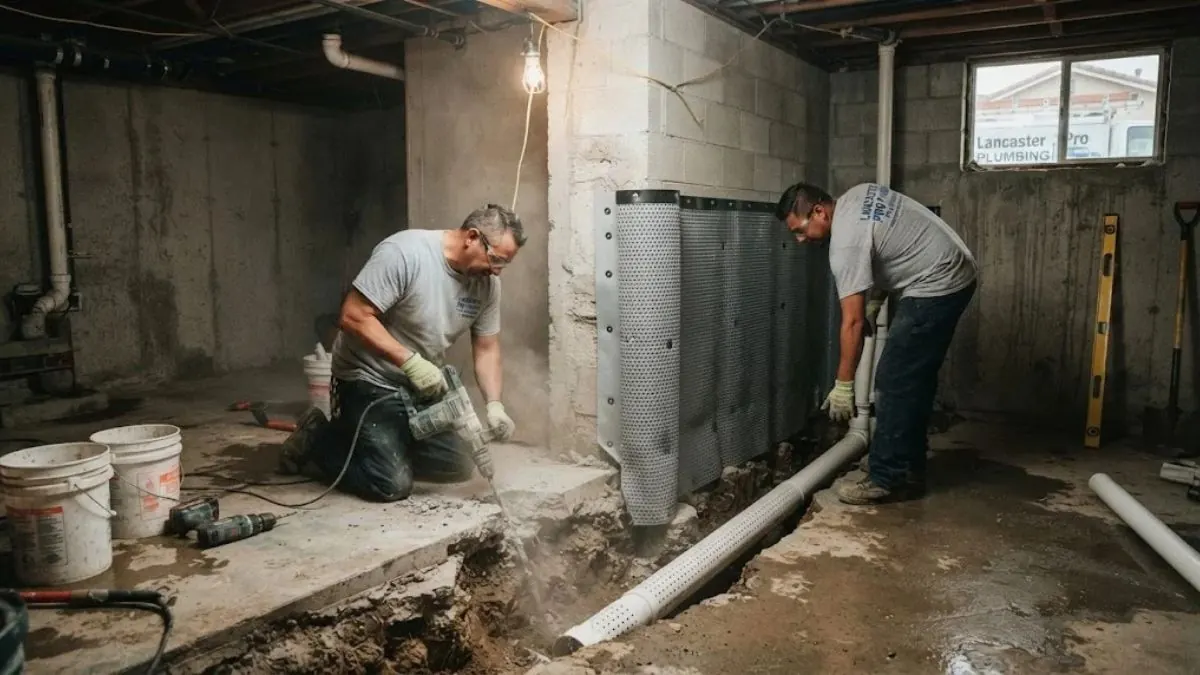
Soil around a foundation fills during storms and the water table rises. That pressure finds the weakest path: the joint where the floor meets the wall, cracks in the slab, rod holes in poured walls and gaps around pipes that enter the house. Gutters that dump at the foundation make it worse.
Look at the grade outside, the downspout ends and any window wells. Cheap fixes like extending downspouts and regrading sometimes solve a lot. When they do not, the answer may be a drain system and pump, which is the work covered under basement waterproofing.
The sump pit as a diagnostic tool
A pit that fills quickly after rain tells you groundwater is the issue. Pour a bucket of water in and listen for the pump to start. A pump that does not run, a stuck float or a pit that overflows means the system needs attention before the next storm.
Danvers flood history and sewer rules
Danvers flooded badly in the Mother's Day Flood of May 2006, when the barriers around the Danvers Electric station were breached. Town hazard planning rates flooding as high frequency and serious, names Beaver Brook, Crane River, Porter River and Waters River among the trouble spots, and lists FEMA zone AE along Beaver Brook and Crane River.
On the sewer side, Danvers requires a backwater valve whenever the basement sewage outlet sits below the rim of the closest public manhole, set before the sewer line exits the house. Sump pumps, downspouts and foundation drains stay off the building sewer. If your basement has a floor drain that gurgles in storms, ask Danvers Inspectional Services whether a backwater valve applies.
Source type: Town of Danvers hazard mitigation and sewer regulations
When sewage is the water
Wastewater on the floor means the drain is blocked or the public main is surcharging. Do not wade in, keep children and pets away, and do not run water above. A backwater valve exists to stop exactly this, since it closes when flow reverses and keeps main line water out of the house.
Nearby towns with the same problem
Brooks and low streets drive the same story across the line. State hazard planning for Peabody calls out Proctor, Goldthwaite and Strongwater Brooks as repeat flooders, so basements near those waterways in Peabody see water the same way. Beverly recorded over 12 inches of rain in the 2006 storm and has named flood-prone spots such as Elliott Street and Federal Street, and a basement drain near coastal or low ground there can back up too.
What to do while you wait
Protect the house first
Some steps are safe to do yourself.
- Turn off power to the basement if water is near outlets or the panel, and do not stand in water to do it.
- Move stored items up onto shelves or tables.
- Photograph the water, the stains and the meter reading.
- If a supply pipe is the source, close the main shutoff.
- Call (855) 575-2890 any hour.
Never step into standing water with the power on. If the panel is wet, leave it alone and call the electric utility.
Wet basement questions
Check timing and the meter. Water that follows rain and leaves the meter still is groundwater. A moving meter on a dry week means a pipe.
It helps with humidity and condensation. It does nothing for liquid water coming through a wall or floor.
It sits on the sewer line and closes when flow reverses, so main sewer water cannot back up through your drains.
Both can be, and that is why diagnosis comes first. Pipes, drains and pumps are plumbing. Foundation cracks and exterior drainage are waterproofing.
Yes when it is rising, it is sewage, or it is near electrical gear. Call the 24/7 line and a licensed plumber is dispatched.
No. The Town prohibits it with no grandfathering, and the sewer regulations say sump pumps may not connect to the building sewer. Discharge goes outdoors, away from the foundation.