What Counts as a Business Plumbing Emergency
Commercial plumbing means the same pipes, drains and fixtures as a house, but at a larger scale and with rules about who can be harmed when something fails. A burst riser floods the units below. A dead floor drain in a kitchen can close you on a health inspection.
According to the Danvers sewer regulations, grease interceptors are required where the Town Engineer finds them necessary, though that standard does not apply to private dwellings.
Call right away for water running through a ceiling, sewage in a floor drain, no water at all to the restrooms, or a main shutoff that will not close. Those jobs cannot wait for a Monday appointment.
While You Wait for the Plumber
These steps limit damage until a licensed plumber arrives.
- Close the building main or the nearest zone valve, and note where it is for the crew.
- Shut off power to anything standing in water at the panel, not with wet hands.
- Lift stock, paper and electronics off the floor and set out wet-floor signs.
- Photograph the leak and the damage before you move things, which helps any insurance claim.
If sewage is involved, keep staff and customers out of the area until it is cleaned and disinfected.
Hunting a Leak You Cannot See
A water bill that keeps climbing in a building with no visible damage usually means a hidden leak. In a commercial space the cause might be a pinhole in copper above a drop ceiling, a failing flush valve, or a supply line buried under the slab or the parking lot.
We start with a meter check: close every fixture, then watch whether the dial still moves. If it does, the leak is real and the next job is narrowing it down. Listening gear, pressure testing in sections and thermal imaging help us find the zone without opening every wall.
Pinpointing a leak and fixing it are separate steps, and we say so up front. Detection tells you where. The repair may mean a small patch or a pipe section replaced, and we explain which before work starts. For underground runs see leak detection, and for a feed pipe outside the building see water service line repair.
Leak, backup or no water at your business?
Call the 24/7 line and a licensed plumber will take it from there.
Grease Traps and Interceptors for Food Businesses
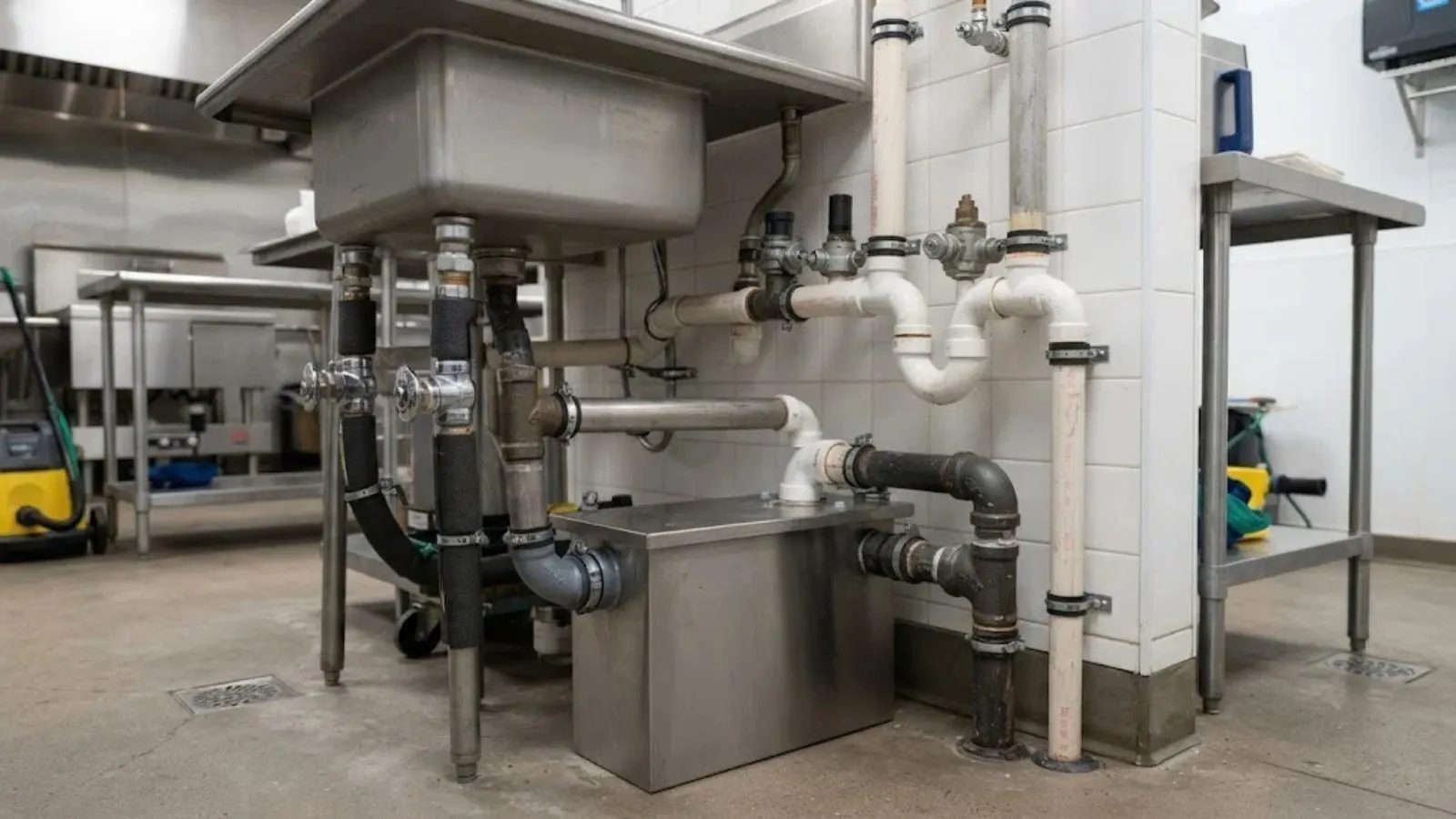
A grease interceptor catches fats and oils before they reach the sewer. Kitchens that skip cleaning end up with slow sinks, foul smells and eventually a backup into the dish pit. A trap that is only cleaned when it overflows has already done damage to the line behind it.
In Danvers, the Town Engineer decides where an interceptor is necessary. The rule applies to commercial buildings and does not apply to private dwellings, so a home kitchen never needs one. If you are opening or changing a food business, ask the Town Engineer before you buy equipment.
Pumping the tank is usually done by a hauler. Our part is the plumbing around it: clearing the line leading to the interceptor, checking baffles and inlet tees, and locating a trap that has lost its lid. A greasy line often needs hydro jetting to strip the wall, since a cable alone just punches a hole through the buildup.
Backflow Testing Twice a Year
A backflow preventer keeps dirty water from flowing backward into the building supply, and from there into the public main. Danvers water regulations call for supply protection under 310 CMR 22.22, and the town requires backflow testing twice a year for devices on a water service. An irrigation system must carry an approved backflow device.
Put the test dates on a calendar. A failed assembly is usually a worn check or relief valve that can be rebuilt, and a quick repair is much easier to schedule than an emergency one. Keep the test report on file, since the Water Division may ask to see it.
Common Jobs by Business Type
| Business | Common problem | What we check | Usual fix |
|---|---|---|---|
| Restaurant | Slow floor drains, grease odor | Interceptor, kitchen branch line | Jetting and trap service |
| Office | Running or leaking toilets, low flow | Flush valves, supply stops | Valve and fixture repair |
| Retail shop | Wet spot, high water bill | Meter test, concealed supply | Leak survey and pipe patch |
| Multi-tenant | Ceiling stains below a unit | Riser, shared drain stack | Isolate section, repair |
| Any site with irrigation | Backflow device fails a test | Check valves, relief valve | Rebuild or replace |
After-Hours and Weekend Work
Many businesses cannot let a plumber in during open hours, so we schedule noisy or disruptive jobs for evenings and weekends when the building is empty. Emergency calls get the same treatment at any hour. If a pipe lets go on a Saturday night, we dispatch a plumber from the 24/7 line.
Tell us who holds the keys, where the main shutoff sits and whether an alarm needs to be disarmed. Having that ready saves time at the door. We also work with landlords and property managers who need written notes on what was found, which we can describe before the job closes.
What Drives the Price
Business plumbing prices vary more than home work, because the building decides much of the job. We give a firm price before work starts, once we see the space.
Water damage from a sudden burst is often covered by a commercial property policy, while slow leaks and wear usually are not. Ask your insurer before repairs, and we can supply photos and notes.
Need a firm number for your building? Call (855) 575-2890
Pairing Commercial Work With Other Services
Many commercial calls turn into a second service once the first is done. A cleared kitchen line may point to a damaged lateral, which leads to sewer line repair. A failed fixture count in an old building sometimes ends in repiping a section. For a quick look at the main line, a camera pass under sewer inspection answers most questions.
We also serve neighboring towns. If your business sits closer to the Peabody line, see our page for a plumber in Peabody.
Business Plumbing Questions
Yes. The 24/7 emergency line dispatches a licensed plumber for burst pipes, sewage backups and failed shutoff valves at any hour, including holidays. Tell the dispatcher the type of business and whether anyone is still inside.
Often yes. We test the meter, pressure test sections of pipe and use listening and thermal tools to narrow the zone before anything is opened. Opening a small, exact spot is far cheaper than guessing.
The Town Engineer decides where one is necessary, and the rule applies to commercial properties only. Ask the Town Engineer before you equip a kitchen, then bring us in for the connecting plumbing.
Danvers water regulations call for testing twice a year. Irrigation systems must also have an approved backflow device.
Yes. Disruptive jobs can be set for evenings or weekends, and urgent calls are answered at any hour.
Yes. Shared risers and stacks need careful isolation so other tenants keep water, and we plan valve shutdowns with the property manager.
You get a clear price before work starts, after we see the space. If we find more once walls or floors open, we stop and explain before going further.